

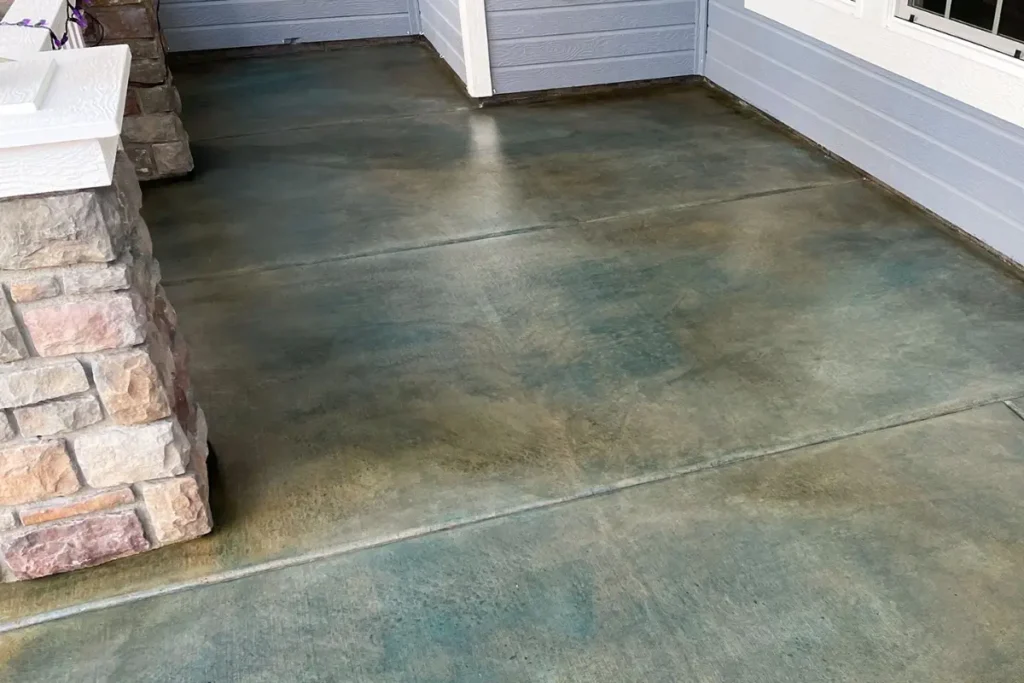
Choosing a concrete stain color feels like it should be simple: pick a color chip, apply it, done. In practice, the color you see on a sample card rarely matches what shows up on your actual driveway, patio, or walkway once it’s finished. Stained concrete color depends on far more than the stain itself, and homeowners who skip that reality often end up disappointed with a result that looked great in a catalog but doesn’t read the same way outdoors, on their specific concrete, in their specific light.
This guide covers the most popular concrete stain colors for Denver homes, what actually affects how those colors turn out, and the mistakes to avoid before you commit to a color.
Why Stain Samples Don’t Match the Final Result
Stain color charts show color applied to a flat, uniform sample under controlled lighting. Your driveway or patio is neither flat nor uniform in the way a sample card is. Concrete has natural variation in texture, porosity, and mineral content, and stain is a reactive or penetrating product, not a paint that sits on top with consistent coverage. The same stain color can look noticeably different on a broom-finished patio versus a smooth-troweled walkway, or on new concrete versus concrete that’s a few years old with different surface porosity.
This is the single most important thing to understand before choosing a color: what you’re picking is a starting point, not a guaranteed outcome. A reputable contractor will test the actual stain on a sample section of your actual concrete, or a comparable slab, before committing to the full project.
Popular Concrete Stain Colors by Application
Driveways
Driveways take the most wear, sun exposure, and tire traffic of any stained surface, so color choices tend to lean toward tones that hide dirt, tire marks, and gradual fading well. Earthy tones like charcoal, slate gray, and terracotta remain the most requested colors for Denver driveways because they read as intentional and finished rather than showing every bit of wear between cleanings.
Patios
Patios are viewed up close and often furnished, so color choices here tend to prioritize how the stain pairs with outdoor furniture, plants, and the house itself. Warm browns, sandstone, and soft tan tones are popular because they read as natural and complement most landscaping. Cooler tones like slate and charcoal work well for patios with a more modern design.
Walkways
Walkways benefit from colors that provide enough contrast with surrounding grass, mulch, or garden beds to visually define the path, without clashing with the home’s exterior. Warm neutrals and mid-tone browns are common choices because they blend naturally into most Denver landscaping while still standing out enough to be functional.
What Actually Changes How a Stain Color Looks
Texture
A broom finish scatters light differently than a smooth trowel finish, which changes how saturated or muted a color appears. The same stain can look richer on a smooth surface and more subdued on a heavily textured one.
Concrete Age and Porosity
Older concrete has different porosity than freshly placed concrete, which affects how deeply and evenly a stain penetrates. This is one of the biggest reasons a stain color used successfully on one project doesn’t automatically translate to another.
Lighting
Direct Colorado sun, shade from trees or structures, and even the time of day can shift how a color reads. A color that looks warm and rich at midday can look flatter under overcast skies or artificial lighting in the evening.
Finish and Sealer
The sealer applied over a stain affects both sheen and color depth. A glossy sealer intensifies color and creates more visual contrast, while a matte or low-sheen sealer produces a more muted, natural look. The same stain color can look like two different products depending on the sealer choice.
Coordinating Stain Colors With Your Home
The most successful stain color choices are made in the context of the whole property, not in isolation. Consider the tones already present in your brick, stone veneer, or siding, and aim for a stain color that complements rather than competes with them. Warm-toned brick generally pairs well with warm stain tones like tan, terracotta, or sandstone, while gray or cooler-toned siding often pairs better with slate, charcoal, or cool gray stains. Existing landscaping features, such as retaining walls, garden beds, or mulch color, are also worth factoring in, since a stained surface sits adjacent to these elements year-round.
Common Color-Selection Mistakes to Avoid
The most common mistake is choosing a color exclusively from a printed or digital sample without seeing it applied to a comparable concrete surface in your actual outdoor lighting. Another frequent mistake is ignoring the finish and texture that will be used, since the same color can look dramatically different across finishes. Homeowners also sometimes choose a color based purely on personal preference without considering how it will coordinate with the rest of the property’s exterior, which can leave the finished surface feeling disconnected from the house. Finally, choosing an overly dark color for a large sun-exposed surface like a driveway without considering heat absorption and fading over time is a common regret.
Why Prep and Application Matter as Much as the Product
Even the right stain color can produce a disappointing result if the concrete surface wasn’t properly cleaned, prepped, and profiled before application. Surface contaminants, inconsistent moisture, and uneven application technique all affect how evenly a stain takes and how the final color reads across the surface. This is why the contractor’s process matters just as much as the stain product itself. A well-prepped surface with careful, even application will produce a more consistent, richer result than a rushed application of a premium stain on an unprepared slab.
Integral Color, Acid Stain and Water-Based Stain
There are three main ways to put color into a concrete driveway, and they behave very differently over time.
Integral color is mixed into the concrete before it is poured, so the color runs through the whole slab. It will not wear off, but it cannot be changed later, and it tends to read softer than a surface stain.
Acid stain reacts chemically with the minerals in the concrete to create mottled, variegated tones. Because it is a reaction rather than a coating, the result depends on the slab, and it is very hard to reverse or lighten once applied.
Water-based stain penetrates the surface and offers a wider and more predictable range of colors. It does not go as deep as integral color, so it relies on a good sealer to hold up, but it can be refreshed or recolored later.
What Colorado Sun and Snow Do to Color
At Denver altitude the sun is stronger than at sea level, and UV is what fades a stained surface first. Earth tones and mid tones tend to fade gracefully, while very dark or very saturated colors show fading and patchiness sooner, especially in the wheel paths.
Winter adds a second layer of wear. De-icers, plowing, and tire traffic wear on the sealer first, and once the sealer is gone the stain underneath is exposed. That is why a sealed stained driveway and an unsealed one look like two different products after a few winters. Regular resealing does more to protect the color than the choice of stain itself.
Choosing a Color That Still Works in Five Years
A color that looks great on a chart can feel wrong once it has sat next to the house for a few seasons. Judge it against your brick, siding, and roof rather than the sample card, and picture it a little faded and a little dusty, not just on day one.
Mid-tone grays, tans, and browns hide dirt, tire marks, and leaves best. Very light colors show every stain, and very dark colors show dust and fade faster in full sun. The only real test is a sample on your actual slab, checked in daylight at different times of day, before the whole surface is stained. If you are planning a new driveway as well as a color, see our concrete driveway service.
FAQ
Will my stained concrete look exactly like the sample color I picked?
Not exactly. Sample cards show color under controlled conditions on a uniform surface. Your actual concrete’s texture, age, and porosity, along with outdoor lighting, will shift how the final color reads. Testing on an actual sample slab beforehand gives a much more accurate preview.
What’s the most popular concrete stain color for driveways in Denver?
Charcoal, slate gray, and terracotta tones are consistently popular because they hide everyday wear well and complement a wide range of home exteriors.
Can I match my stained concrete color to my brick or siding?
Yes, and it’s worth doing. Warm-toned brick pairs well with warm stains like tan or terracotta, while cooler-toned siding pairs better with gray or slate stains.
Does the finish type change how a stain color looks?
Yes. A broom finish and a smooth trowel finish reflect light differently, which changes how saturated or muted the same stain color appears once applied and sealed.
Get Expert Guidance on Your Concrete Stain Color
Choosing the right stain color takes more than a color chart. Cain Construction Company works with Denver homeowners to test colors on real samples and apply them with the prep and technique needed for a consistent, long-lasting finish. Contact Cain Construction Company to discuss stain options for your driveway, patio, or walkway.