

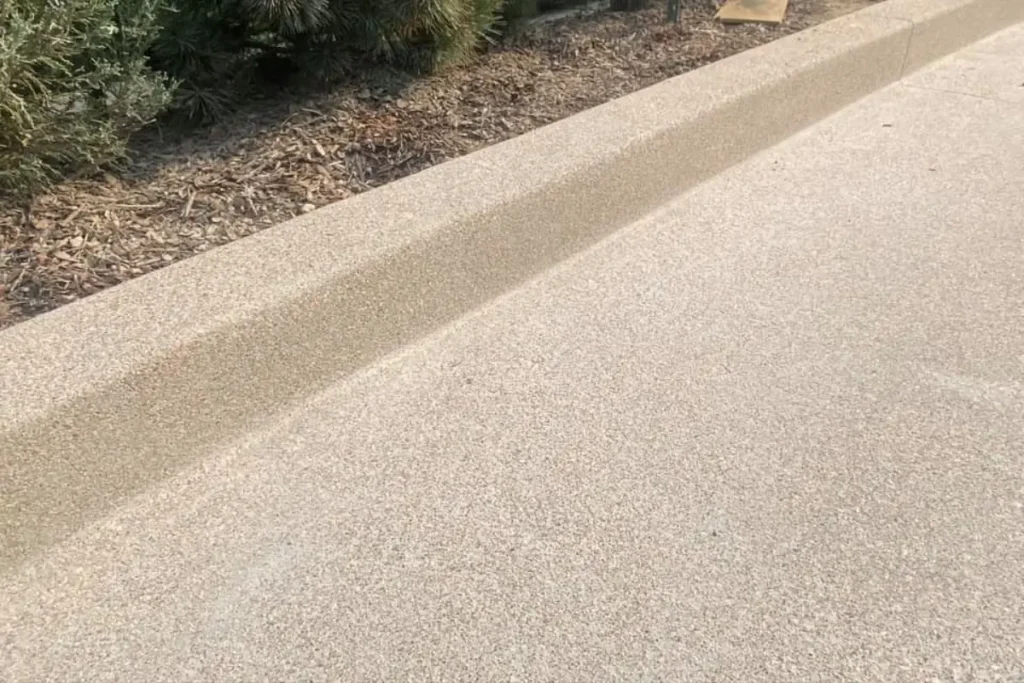
Curb and gutter systems are among the most overlooked components of a well-functioning roadway or site, yet they do critical work every time it rains or snow melts. For municipalities, developers, general contractors, and property managers planning street, parking lot, or subdivision work in the Denver area, understanding how these systems function and what proper installation requires is essential to avoiding drainage failures and pavement damage down the road.
How Curb and Gutter Systems Collect and Direct Stormwater
A curb and gutter system’s primary job is managing water at the edge of a paved surface. The gutter section, typically a shallow concrete channel adjacent to the curb, collects runoff from the roadway or parking surface and channels it along a controlled path. The curb itself defines the edge of the pavement, contains vehicle traffic, and works with the gutter to direct water flow toward a collection point rather than letting it sheet uncontrolled across pavement, sidewalks, or adjacent property.
Without a functioning curb and gutter system, water finds its own path, which usually means pooling in low spots, eroding unpaved shoulders, or flowing onto sidewalks and building entrances. A properly designed and installed system takes that uncertainty out of the equation.
How Curbs, Gutters, Catch Basins, Sidewalks, and Pavement Work Together
Curb and gutter systems don’t function in isolation. They’re one part of an integrated drainage network. Water collected in the gutter flows along the curb line to catch basins or inlet structures, which route it into underground storm drainage piping and eventually to a detention pond, stream, or municipal storm system. Sidewalks are typically set behind the curb at a defined elevation, and pavement structure is designed with cross-slope that directs surface water toward the gutter rather than away from it. When any one of these elements is out of alignment, whether it’s a curb poured at the wrong elevation or a catch basin set too high, the whole drainage system underperforms and water problems show up somewhere in the network.
Grading, Slope, and Elevation Requirements
Proper curb and gutter performance depends on precise grading work completed before and during installation.
Longitudinal Slope
The gutter line needs sufficient slope along its length to keep water moving toward collection points rather than pooling. Flat or reverse-graded sections are one of the most common causes of standing water complaints after installation.
Cross Slope
Pavement adjacent to the curb needs correct cross-slope so water actually reaches the gutter instead of sheeting across the travel lane or parking surface.
Elevation Control
Curb and gutter elevations must be set relative to adjacent pavement, sidewalks, and inlet structures with tight tolerances. Even small elevation errors can create ponding at low points or prevent water from entering catch basins as designed.
Getting these numbers right requires careful survey work, accurate grade stakes, and a paving crew experienced in reading and executing civil grading plans, not just placing concrete to a rough line.
Applications Across Denver-Area Projects
Curb and gutter work shows up in a wide range of project types:
- Municipal streets, where curb and gutter is a core component of public right-of-way infrastructure and subject to specific municipal standards and inspection.
- Commercial developments, including retail centers, office parks, and mixed-use sites, where curb and gutter manage drainage around buildings, drive aisles, and loading areas.
- Parking lots, where curb islands, perimeter curbs, and gutter sections control water flow across large paved areas and protect landscaped islands.
- Residential subdivisions, where curb and gutter along streets is typically required by local development standards and ties directly into the neighborhood’s overall stormwater plan.
How Proper Installation Reduces Erosion, Standing Water, and Pavement Deterioration
Water is the single biggest driver of pavement failure. When curb and gutter systems function correctly, they keep water off the pavement surface and away from the subgrade beneath it, which is what actually holds the pavement structure together. Poorly installed or failing curb and gutter allows water to infiltrate the base beneath adjacent pavement, weakening it and accelerating cracking, potholing, and edge failure. It also allows erosion at unpaved shoulders and landscaped areas, and it creates standing water that becomes a hazard in freezing conditions, a real concern in Denver’s climate. Getting the system right the first time protects the pavement investment around it for the life of the roadway or lot.
Reinforcement, Placement, Joint Spacing, and Curing for Long-Term Performance
Concrete curb and gutter sections, while smaller in cross-section than a structural slab, still require careful construction practices for long-term durability:
- Reinforcement is used selectively depending on application, with dowels or tie bars often placed at joints connecting curb sections to adjacent pavement.
- Concrete placement typically uses a slip-form curb machine on larger municipal and commercial projects for consistent cross-section and grade, or hand-formed methods on smaller or more complex sections.
- Joint spacing follows standard intervals to control cracking as the concrete shrinks during curing, with joints typically matched to adjacent pavement joints where possible to avoid conflicting crack patterns.
- Curing practices, including curing compound application and protection from rapid drying or freezing temperatures, directly affect the long-term strength and durability of the finished curb and gutter section.
Skipping or rushing any of these steps shows up later as premature cracking, spalling, or joint failure, problems that are far more expensive to fix after the fact than to do right during installation.
When Curb and Gutter Work Is Part of a Larger Site Development Project
Curb and gutter installation is rarely a standalone task. It’s typically one piece of a broader civil site development or roadway improvement project that includes grading, storm drainage installation, paving, and sidewalk construction. Coordinating curb and gutter work with these other trades and with the overall site drainage design is essential to avoiding conflicts and rework. Experienced contractors work from civil engineering plans and coordinate sequencing with other site work so that curb and gutter installation supports the larger drainage strategy rather than working against it.
FAQ
What’s the difference between curb and gutter versus a standalone curb?
A standalone curb only defines the pavement edge and contains traffic. A curb and gutter system adds an integrated concrete channel that actively collects and directs stormwater runoff to a drainage point.
How often do curb and gutter systems need to be replaced?
With proper installation and normal maintenance, concrete curb and gutter can last several decades. Replacement is typically driven by settlement, joint failure, freeze-thaw damage, or roadway reconstruction projects rather than routine wear alone.
Do municipal projects have specific standards for curb and gutter construction?
Yes. Most municipalities maintain detailed standard drawings and specifications covering curb profile, gutter cross-slope, reinforcement, and inspection requirements. Cain Construction Company builds to these standards on public infrastructure work.
Can curb and gutter be installed on an existing parking lot without full reconstruction?
In many cases, yes, particularly when the goal is improving drainage on an existing site. However, tie-in elevations and grading need careful evaluation to make sure the new curb and gutter work correctly with existing pavement grades.
What happens if curb and gutter is installed with the wrong slope?
Incorrect slope leads to standing water, which accelerates pavement deterioration, creates ice hazards in winter, and often requires costly corrective work to fix. Accurate grading during installation is critical to avoiding this.
Ready to Start Your Curb and Gutter Project?
Whether you’re planning a municipal street project, a commercial development, or a parking lot improvement, Cain Construction Company has the experience to design and build curb and gutter systems that perform for the long term. Contact Cain Construction Company today to discuss your project and get started.