

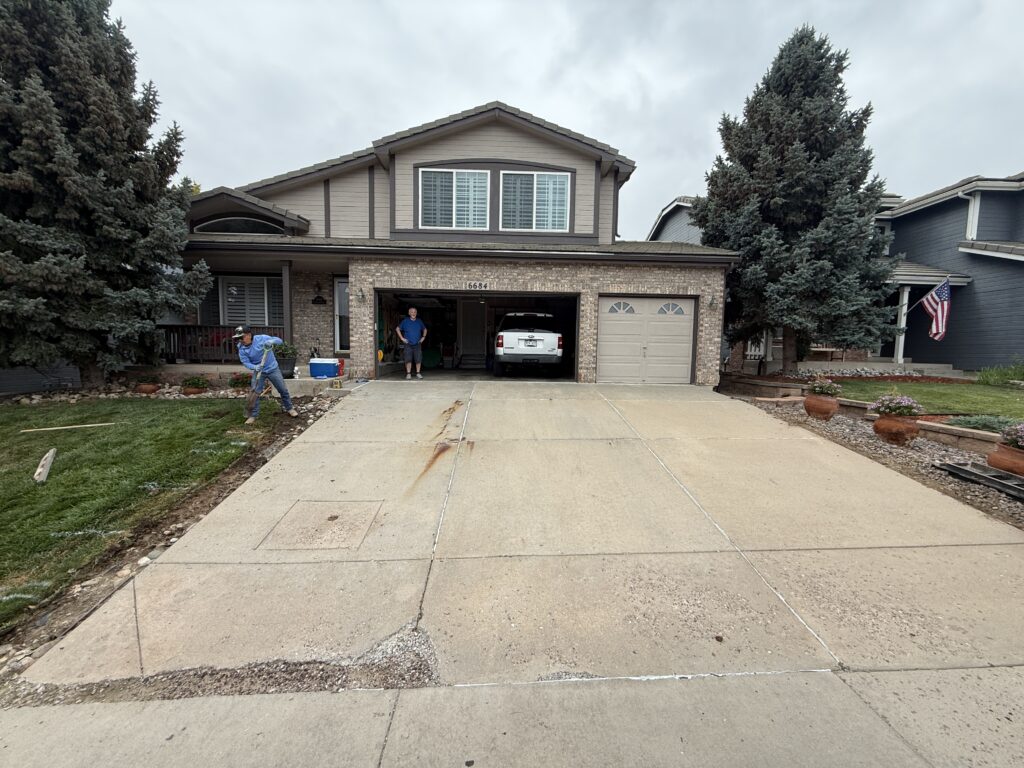
Let’s start with the uncomfortable truth: every concrete driveway will develop some cracking over its life. Concrete is strong in compression and weak in tension, and the ground it sits on moves. A good driveway isn’t one that never cracks — it’s one where cracking is controlled, minor, and doesn’t threaten the slab.
The reason Colorado driveways crack more, and worse, than driveways in milder places comes down to our specific conditions. Understand those and you understand both the problem and the fix.
Freeze-thaw is the main culprit
Denver and the Front Range don’t have one long freeze like the upper Midwest. We have something arguably harder on concrete: repeated freeze-thaw cycling. A sunny winter afternoon thaws the surface, the temperature drops below freezing overnight, and it refreezes. We can run through dozens of these cycles in a single season.
Here’s why that wrecks concrete. Concrete is porous. It absorbs water. When that water freezes it expands by roughly nine percent, pushing outward inside the concrete’s pore structure. Thaw, refreeze, expand again — the internal pressure builds and breaks the surface apart. You see it as scaling (the top layer flaking off) and as cracking that widens season over season.
The defense against this is built in at the pour, not added later:
- Air entrainment. Properly air-entrained concrete has microscopic air bubbles that give freezing water somewhere to expand into, relieving the pressure. For any exterior slab in Colorado this isn’t optional. Concrete mixed without it is far more likely to scale and spall.
- A correct water-to-cement ratio. Over-watered "soupy" concrete — easier to place, so lazy crews like it — cures weaker and more porous, which means it soaks up more water and fails faster in freeze-thaw.
- Proper curing. Concrete gains strength over weeks, not hours. Rushing it or letting it dry out too fast leaves a weaker surface.
This is the same climate physics behind decorative work failing, which we cover in common stamped-concrete mistakes.
Colorado’s expansive clay soil
The second big factor is under the slab. Much of the Front Range sits on expansive clay soils — bentonite-heavy ground that swells dramatically when it takes on water and shrinks as it dries. That’s a huge amount of vertical movement happening right under your driveway.
If the slab is poured on poorly prepared or poorly draining subgrade, the soil heaves in one spot and settles in another. The concrete, bridging that moving ground, cracks along the stress line. This is why base preparation is the single most important thing you can’t see once the job’s done. A compacted, properly graded gravel base that drains water away from the slab is what keeps the ground underneath stable.
We treat subgrade prep as the foundation of the whole job, not a step to trim from a bid. There’s a full explanation in why flatwork prep is important, and it applies to every concrete driveway we pour.
Missing or badly placed control joints
Since concrete is going to crack, the professional move is to decide in advance where. That’s what control joints do — they’re the tooled or saw-cut grooves that create a deliberate weak line, so when the slab shrinks and stresses, it cracks cleanly along the joint instead of randomly across the middle of your driveway.
Two things go wrong here:
- Too few joints, spaced too far apart. There’s a rough rule of thumb tying joint spacing to slab thickness. Space them too far and the slab cracks between them where you didn’t want it.
- Joints cut too late. Saw-cut joints have a timing window. Cut them too late and the slab has already started cracking on its own.
Control joints won’t stop a driveway from ever showing a line — they channel the inevitable into a place that looks intentional and stays tight.
Curing in the wrong conditions
When a driveway is poured matters as much as how. Concrete poured into extreme heat can cure too fast and crack from shrinkage; poured too close to a hard freeze without protection, it can be damaged before it ever reaches strength. That short window is why we’re honest with people about the calendar and sometimes recommend waiting for better conditions. Our approach to cold-season work is written up in how we handle winter concrete projects in Colorado.
De-icing salts: the damage you cause yourself
This one’s on the homeowner, and it’s common. Reaching for rock salt or de-icing chemicals on a fresh driveway is one of the fastest ways to destroy the surface.
De-icers force extra freeze-thaw cycles by repeatedly melting and refreezing water on the slab, and some chemicals attack the concrete directly. A driveway in its first winter is especially vulnerable — the surface hasn’t fully matured. The better move is to skip chemical de-icers, use sand for traction, and clear snow mechanically. If keeping the driveway clear through the winter is the real goal, a heated driveway melts snow without any salt touching the concrete at all.
How to actually prevent it
Pulling it together, a Colorado driveway that resists cracking comes from:
- A compacted, well-draining base built for expansive soil
- Air-entrained concrete with a proper mix, not over-watered
- Control joints placed correctly and cut on time
- Adequate slab thickness for the loads it’ll carry
- Pouring in suitable weather and curing it properly
- No de-icing salts, especially in year one
Notice that five of those six happen before your driveway is even usable. Cracking is decided at the pour. The crew you hire and the corners they don’t cut are what you’re really paying for.
If you’re comparing surfaces before you commit, our honest concrete vs. asphalt driveway guide lays out the trade-offs for our climate.
Next read: 5 Costly Stamped-Concrete Mistakes (and How to Avoid Them)