

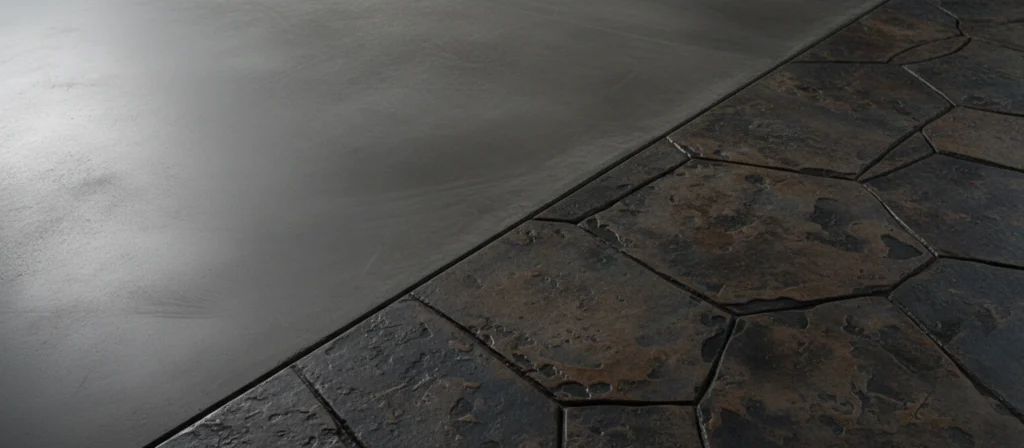
Stamped concrete looks great in a brochure. In real life, it either ages into a surface you’re proud of for 20 years, or it starts flaking, fading, and cracking inside two winters. The difference almost never comes down to the stamp pattern. It comes down to what happened before, during, and after the pour.
We pour a lot of decorative flatwork across the Front Range, and we get called out to fix other crews’ work often enough to see the same failures repeat. Here are the five that cost homeowners the most, and how to keep them off your project.
1. Skipping the base prep
This is the big one, and it’s invisible once the concrete is down, which is exactly why cut-rate crews cut it here first.
Stamped concrete is still concrete. It needs a compacted, well-draining subgrade underneath it — usually a properly graded gravel base, compacted in lifts, not a scoop of dirt raked flat and poured over. In Colorado, our expansive clay soils swell when wet and shrink when dry. If the ground under your slab moves and the base wasn’t built to handle it, the slab moves too. Then it cracks, and no stamp pattern hides a crack running across your patio.
Good base prep also means the pad drains. Water that sits under or against the slab freezes, expands, and lifts. You can’t see any of this after the concrete cures, so you have to trust the crew doing it right when nobody’s watching. Ask how they’re preparing the subgrade and how thick the base is before you sign anything. We wrote a full breakdown of why the prep under flatwork matters more than the finish on top if you want the detail.
2. Sealing it wrong (or not at all)
Sealer is where a lot of stamped jobs quietly go sideways, because the mistakes take a season to show up.
Two common versions:
Sealing too soon. Fresh concrete needs to release moisture as it cures. Trap that moisture under a film-forming sealer applied too early and you get a cloudy, white, blushed surface that looks like fog under the finish. Once it’s sealed in, fixing it means stripping the sealer and starting over.
Over-sealing. More coats is not better. Pile on too much film-forming sealer and the surface gets glassy, slick when wet, and prone to peeling in sheets. On a north-facing walk that ices up, a slick sealer is a safety problem, not just a looks problem.
Then there’s the opposite mistake — never resealing. Stamped concrete needs a fresh coat of sealer on a cycle, typically every couple of years in our climate, because UV and freeze-thaw wear the film down. Skip it and the color dulls fast and the surface loses its defense against moisture. The right product and the right timing matter, which is part of why we treat release colors and finishing as its own step, not an afterthought.
3. Expecting the color to never change
Every homeowner wants the patio to look the day it was poured forever. Concrete color does not work that way, and a contractor who promises it never fades is setting you up to be disappointed.
Integral color, color hardener, and release agents all behave differently. Release agents especially create depth and antiquing, but they’re a surface effect that wears with traffic and weather. Direct Colorado sun is hard on color — UV at altitude is stronger than most people expect, and it will lighten pigments over time. That’s normal. It’s also why resealing matters, because the sealer is what protects and revives the color.
The fix here is expectation-setting plus product choice. A good crew steers you toward color systems that age gracefully and warns you where fading will show most. If you’re still choosing, our guides on concrete color options and stamped color combinations walk through what holds up and what to expect.
4. Ignoring cracks — or pretending they won’t happen
Concrete cracks. All of it, eventually, to some degree. The honest version of this trade tells you that up front and then works to control where and how.
Control joints are the tool. They’re the grooves cut or tooled into the slab that give it a planned, hidden place to crack instead of a random one across your stamp pattern. On stamped work, joints get placed to line up with the pattern so they read as part of the design. A crew that doesn’t plan joints, or spaces them too far apart, is gambling with your patio.
Colorado’s freeze-thaw cycle makes this worse than in milder climates. Water gets into the concrete, freezes overnight, expands, thaws by afternoon, and does it again — dozens of times a winter. That cycle drives cracking and surface scaling, especially on slabs that weren’t air-entrained or finished correctly. The same physics is why so many driveways fail here, which we cover in why concrete driveways crack in Colorado.
5. Hiring the wrong contractor for the season
Stamped concrete is time-sensitive work. Once it’s poured, the crew has a narrow window to stamp before it sets, and finishing conditions — temperature, sun, wind — change how the whole thing cures. Get the timing wrong and you get poor stamp detail, surface crazing, or a weak top layer that scales off.
Pouring in the wrong conditions is the classic version. Concrete poured too late in the fall, or into a hard overnight freeze without protection, can be compromised before it ever gains strength. Reputable crews plan around the weather, protect fresh pours, and will tell you honestly when it’s smarter to wait for spring. We put our own approach in writing in how we handle winter concrete projects in Colorado.
The wrong contractor also shows up in the small stuff: no clear plan for joints, vague answers about base prep, a bid that’s suspiciously cheap because prep and sealing got trimmed out. The cheapest stamped patio is almost always the most expensive one, because you pay for it twice.
The short version
Base prep, sealing, realistic color expectations, planned control joints, and a crew that respects the season. Get those five right and stamped concrete is one of the best-value upgrades you can make to a home. Get them wrong and it’s a repair project waiting to happen.
If you’re weighing a stamped patio or driveway, look at our stamped concrete work and the honest stamped vs. sand-finish comparison before you decide.
Next read: Why Concrete Driveways Crack in Colorado (and How to Prevent It)