

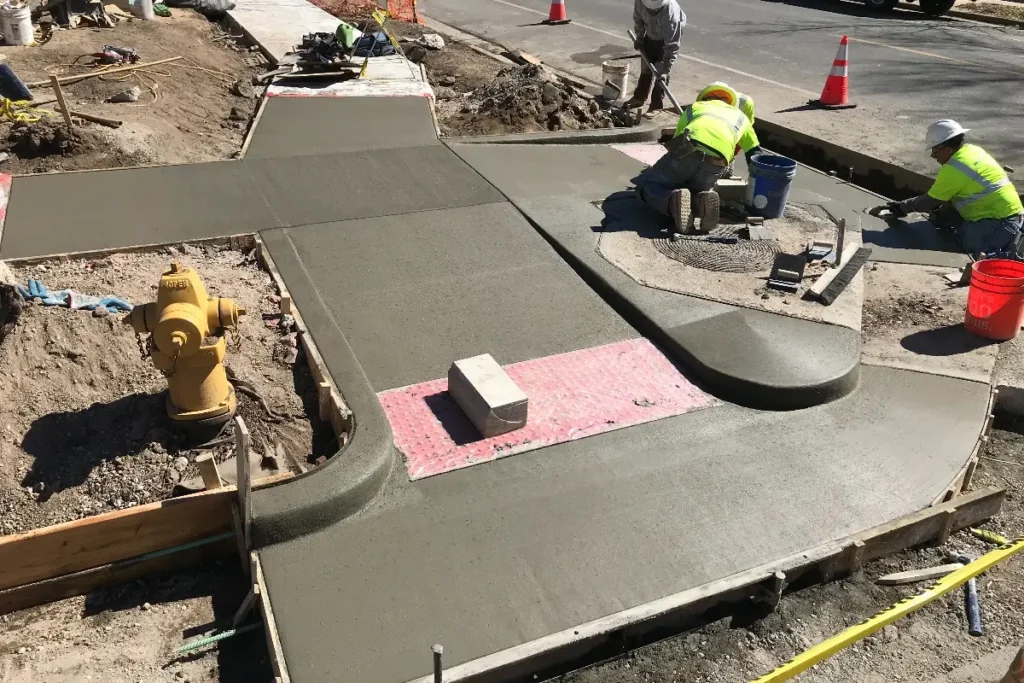
A cracked or heaving sidewalk is more than a cosmetic problem. It’s a liability, a tripping hazard, and often a sign of deeper issues below the surface. For homeowners, HOAs, property managers, and commercial property owners across Denver, knowing when to repair a sidewalk versus replace it outright can save money and prevent repeat problems. This guide walks through the signs that point to full replacement, what the process involves, and the site conditions that shape planning and cost.
Why Some Sidewalks Need Full Replacement Instead of Repair
Patching a sidewalk works when damage is isolated and the underlying base is sound. But once a walkway shows widespread deterioration, patching becomes a short-term fix that fails again within a year or two. Full replacement makes sense when you see:
- Multiple cracked or broken panels across a run of sidewalk rather than a single isolated slab.
- Trip hazards from vertical displacement, where adjacent panels have settled or heaved unevenly, often more than a half inch, which is enough to trigger ADA and municipal liability concerns.
- Standing water or poor drainage that pools on the surface instead of shedding toward the street or a swale.
- Settlement, where sections of sidewalk have sunk due to poor compaction, erosion, or a failed subgrade.
- Tree root damage, where roots have lifted, cracked, or undermined the slab from below. Grinding down a root-heaved panel is a temporary fix at best; the root keeps growing.
- Freeze-thaw deterioration, common in Denver’s climate, where repeated freeze-thaw cycles combined with de-icing salts cause surface scaling, spalling, and internal cracking that spreads through the concrete.
When damage is this widespread, repeated patch repairs cost more over time than a single, properly executed replacement. Each patch is a new joint, a new potential failure point, and a mismatched surface that ages differently than the surrounding concrete.
The Sidewalk Replacement Process
Demolition and Removal
The first step is removing the existing concrete. This typically involves saw-cutting clean edges at the panel joints so the new work ties in cleanly, then breaking out and hauling away the old slab. Careful demolition protects adjacent driveways, curbs, landscaping, and utility lines.
Base Preparation and Grading
Once the old concrete is out, the subgrade gets inspected and corrected. This is often where the real problem was hiding. Soft spots, organic material, or poorly compacted fill get removed and replaced with properly compacted aggregate base. Grading is set to match required slope for drainage, typically a slight cross-slope directing water away from the walking surface and toward the street or a drainage path, while keeping within ADA slope limits for accessible routes.
Forming and Reinforcement
Wood or metal forms establish the new sidewalk’s width, thickness, and alignment. For most residential and light commercial sidewalks, reinforcement includes wire mesh or rebar, particularly at panel edges and any sections that will bear heavier loads, such as driveway approaches or areas near loading zones. Control joints are placed at regular intervals to manage where the concrete cracks as it cures and shrinks.
Concrete Placement and Finishing
Concrete is placed, consolidated, and screeded to grade. Finishing follows immediately, with a broom finish typically applied for slip resistance, which matters for a walking surface exposed to rain, snow, and ice. Edges are tooled, joints are cut or tooled to the correct depth, and curing compound is applied to protect strength gain, especially important during Denver’s temperature swings.
Connecting New Sidewalks to Driveways, Steps, and Streets
A sidewalk rarely exists in isolation. New sidewalk sections need to tie into driveway aprons, front steps, curb ramps, and adjoining walkway segments without creating new trip hazards or drainage conflicts. This means matching elevations at every transition point, coordinating joint placement so the new work doesn’t crack away from existing structures, and verifying that curb ramps at street crossings meet current accessibility requirements. On commercial and municipal projects, this coordination often extends to ADA-compliant detectable warning surfaces at street crossings and confirming continuous accessible routes across the property.
Factors That Affect Cost, Timeline, and Accessibility
Several variables shape the scope and cost of a sidewalk replacement project:
- Square footage and thickness required for the application, with heavier-duty sidewalks needed where vehicle crossings or heavy foot traffic are expected.
- Site access, including how easily equipment and concrete trucks can reach the work area, particularly in dense residential or urban commercial settings.
- Removal complexity, such as extensive tree root systems, utility conflicts, or old sidewalk sections tied into deteriorated curb structures.
- Base conditions, since poor subgrade often requires more excavation, import fill, and compaction effort than initially expected.
- Weather and cure time, since concrete needs adequate time to gain strength before foot traffic resumes, and cold-weather placement requires additional protection measures.
- Accessibility during construction, since sidewalks serve as pedestrian routes. Projects often require temporary pathways, signage, or phased work to keep property accessible while replacement is underway, particularly for HOAs and commercial properties with regular foot traffic.
Why Full Replacement Outperforms Repeated Patch Repairs
Patch repairs address symptoms, not causes. If the underlying base is compromised, a patch will crack again as the same forces that caused the original damage continue to act on the new material. Full replacement addresses the base, the drainage, and the structural elements at once, producing a walkway that performs consistently for decades rather than one that needs revisiting every couple of years. For property owners tracking long-term maintenance budgets, one well-executed replacement is typically more cost-effective than a cycle of partial repairs that never fully solve the problem.
FAQ
How long does concrete need to cure before a new sidewalk can be used?
Concrete typically reaches enough strength for foot traffic within 3 to 5 days, though full cure and strength gain continues for about 28 days. Cain Construction Company will advise on specific timing based on weather and mix design for your project.
Can a sidewalk be replaced in sections instead of all at once?
Yes. Sectional replacement is common, especially for HOAs and commercial properties that need to maintain accessible pathways throughout the project. This approach lets work proceed in phases while keeping disruption manageable.
What causes sidewalks to heave or crack in the first place?
Common causes include freeze-thaw cycling, tree root growth beneath the slab, poor original base compaction, drainage issues that saturate the subgrade, and normal settlement over time. Identifying the cause helps determine whether repair or replacement is the right fix.
Do new sidewalks need to meet ADA requirements?
Yes, particularly for commercial properties, municipal projects, and public rights-of-way. This includes slope limits, cross-slope requirements, and detectable warning surfaces at curb ramps. Cain Construction Company designs new sidewalk work to meet current accessibility standards.
How much does sidewalk replacement typically cost?
Cost depends on square footage, base conditions, site access, and design requirements. Because every property’s conditions differ, Cain Construction Company provides a site-specific estimate after evaluating the existing sidewalk and surrounding grade.
Ready to Replace Your Sidewalk?
If your property has damaged, uneven, or aging sidewalks, Cain Construction Company can evaluate the site and recommend the right path forward. Contact Cain Construction Company today to schedule an assessment and get a clear plan for your sidewalk replacement project in the Denver area.