

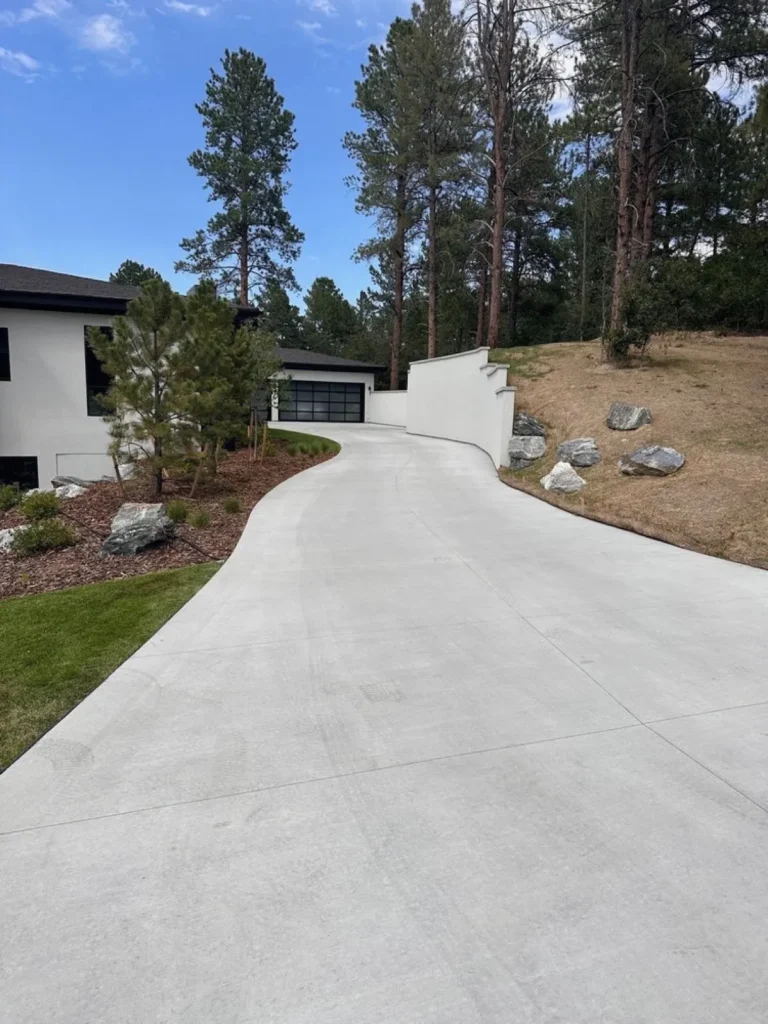
Concrete driveway maintenance in Colorado is mostly about two things: keeping water from getting into places it does not belong, and keeping de-icing chemicals off a surface that is already being freeze cycled forty or more times a winter. Do those two well and a properly built slab outlives the people who ordered it. Ignore them and a good driveway ages like a bad one.
This is the routine we give clients, organised by what actually needs doing and when.
Understand what you are protecting against
Three mechanisms do almost all the damage to residential concrete on the Front Range.
Freeze and thaw. Water that has soaked into the top few millimetres of concrete expands as it freezes. Air entrained concrete has microscopic voids that give that ice somewhere to go, which is why the mix matters, but no mix is helped by standing water.
De-icing salts. Chloride based products do not attack concrete directly so much as they drive more freeze and thaw cycles by melting and refreezing, and they carry chloride down to any reinforcing steel. First winter concrete is the most vulnerable, because it has not finished gaining strength.
Water under the slab. The quiet one. Water that gets into an open joint or a crack reaches the base, softens it, and on expansive clay makes the ground move. That produces settlement and rocking panels, which no surface treatment fixes.
The first year is different
New concrete needs a season of restraint. Keep de-icing chemicals off it entirely through the first winter and use sand for traction instead. Keep heavy vehicles off it for the period your contractor specifies, not the period that feels reasonable. Wait to seal until the slab has cured properly, because a sealer applied too early traps moisture in a surface that is still releasing it.
Our article on curing time and when you can drive on new concrete covers the return to service schedule in detail.
Twice a year: walk it and look at the joints
Every spring and every autumn, spend fifteen minutes on the driveway with a screwdriver in your hand.
Look at the control joints. They should be filled or sealed, and the sealant should be intact, flexible and not pulled away from either side. Where the joint sealant has failed, water goes straight through to the base. This is the single highest value maintenance item on a concrete driveway and the one most often skipped.
Look at the expansion or isolation joints where the driveway meets the garage apron, a public sidewalk, or a wall. Those move the most and the joint material tends to compress and pull loose over time.
Probe any crack wider than a business card with the screwdriver. If the edges are sound and the two sides are level with each other, it is a surface matter. If one side sits higher than the other, or the edge crumbles under the screwdriver, the base under it is moving or eroding, and that is a structural conversation. Our guide on why concrete driveways crack in Colorado explains how to read what you are seeing.
Keep water moving away
Most driveway problems start as drainage problems. Downspouts that dump onto the slab or beside its edge saturate the base. Landscaping that has been built up over the years reverses the grade and holds water at the edge. An irrigation head aimed at the concrete keeps one strip permanently damp, which is where scaling starts.
Fix the water first. Extend the downspouts past the concrete. Cut back the soil so the ground falls away from the edge instead of toward it. Redirect the sprinkler. These are afternoon jobs that prevent five figure problems.
Sealing: what it does and what it does not
A penetrating sealer, usually a silane or siloxane, soaks into the surface and reduces how much water and chloride the concrete absorbs. It does not change the appearance much and it does not create a film that can peel. For exposed exterior concrete in a freeze and thaw climate, this is the sensible default.
Film forming acrylic sealers sit on the surface, deepen the colour and give decorative concrete its sheen. They are what stamped and stained surfaces need, and they need renewing more often because ultraviolet exposure and traffic wear them down. Applied too thick, or applied over damp concrete, they can turn white or peel.
Reseal on condition rather than on a calendar. Splash water on the driveway. If it beads, the sealer is working. If it soaks straight in and darkens the concrete, it is time. Timing matters too: seal in dry weather with moderate temperatures, on a clean and dry surface, and not late in the day in autumn when the surface will not be dry before it gets cold.
Winter practice
Use sand for traction wherever you can. If you must use a de-icer, calcium magnesium acetate and magnesium chloride are gentler on concrete than rock salt, and less is more with all of them. Never use anything containing ammonium sulphate or ammonium nitrate, which are sold as fertiliser and attack concrete directly.
Shovel before the traffic packs the snow. Use a plastic edged shovel or set the blade of a snow blower slightly high so it does not catch a joint or an edge. And take the slush off the surface once things are melting, because melted snow refreezing in the evening is exactly the cycle that lifts the surface off.
If a shaded, north facing driveway or a slope makes this a permanent battle, a heated driveway removes the problem rather than managing it, which we weigh up in our article on whether heated driveways are worth it in Colorado.
Cleaning without doing damage
Rinse the driveway occasionally, especially at the end of winter, to get the chloride residue off. Oil drips are best treated while fresh with an absorbent and a degreaser rather than left to soak in.
Pressure washing is fine within limits. Keep the tip moving, use a wide fan tip, and hold the wand back from the surface. A narrow tip held close will cut lines into the paste and expose the aggregate, and on a decorative surface it will strip the sealer unevenly. Never pressure wash concrete in its first year.
When concrete driveway maintenance stops being the answer
Joint sealing, cleaning and resealing keep a sound slab sound. They do not correct a slab whose base has failed. If panels rock underfoot, if a crack has vertical displacement across it, if the surface is scaling in sheets over a wide area, or if a section has settled enough to pond water, the decision has moved on. That is the subject of our guide on repairing, resurfacing or replacing a driveway.
If you want a second opinion on what you are looking at, the fastest route is a photograph and a short description through our quote request, or start from the driveway service page.
When maintenance is no longer enough, see our concrete driveway replacement service.
Frequently asked questions
How often should a concrete driveway be sealed in Colorado?
Test rather than guess. Splash water on the surface and watch it. Beading means the sealer is still working, and rapid absorption with a dark patch means it is due. Exposed south facing slabs and heavily trafficked areas lose their sealer faster than shaded, lightly used ones, so one driveway can need attention in one area and not another.
Can I use ice melt on a new concrete driveway?
Not in the first winter. New concrete is still gaining strength and is at its most vulnerable to the extra freeze and thaw cycling that de-icers create. Use sand for traction through the first season, and after that use the least aggressive product that does the job, applied sparingly.
Should the control joints in my driveway be filled?
Yes, with a flexible sealant that lets the joint open and close. The joint exists so that cracking happens in a straight line where you chose it, but an open joint also lets water reach the base. Checking and renewing joint sealant is the highest value fifteen minutes you will spend on the driveway all year.
Will pressure washing damage my driveway?
It can. A narrow tip held close to the surface erodes the cement paste and leaves visible wand marks, and on decorative concrete it strips sealer in patches. Use a wide fan tip, keep the wand moving and hold it back from the slab. Do not pressure wash concrete that was poured within the last year.
What is the difference between a penetrating sealer and an acrylic sealer?
A penetrating sealer soaks in and reduces water and chloride absorption without forming a film, so it cannot peel and barely changes the look. An acrylic sits on top, enriches colour and gives decorative surfaces their sheen, but it wears faster and can whiten or peel if it is applied over damp concrete or laid on too heavily.