

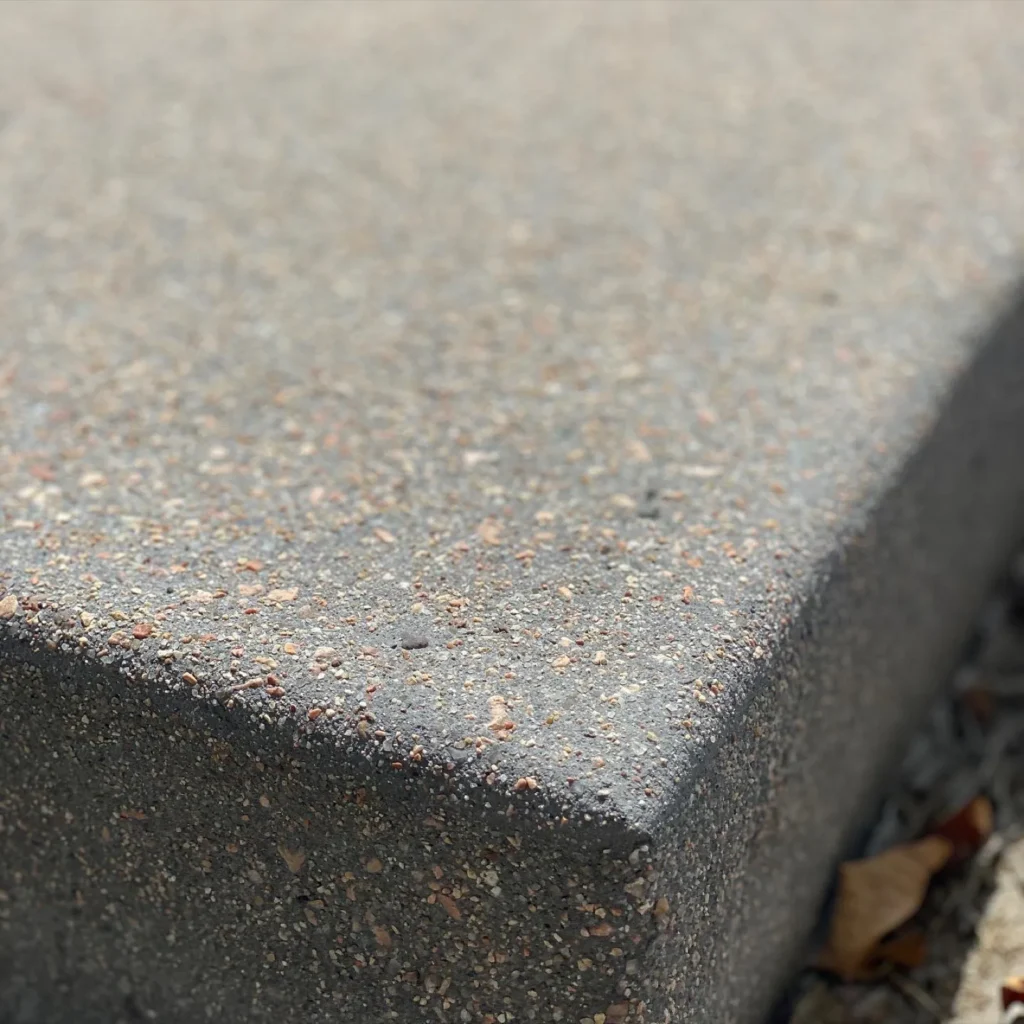
Concrete spalling and scaling is the failure homeowners notice first, because it happens where you walk. The top skin of the slab flakes, then chips, then goes altogether, leaving a rough exposed surface that holds water and gets worse every winter.
It is almost never caused by the thing people blame. The salt gets blamed, and the salt is a contributor, but the reason one driveway scales after two winters and its neighbour does not comes down to decisions made on the day the concrete was placed.
Scaling, spalling and crazing are three different things
Scaling is the loss of the surface mortar in flakes, usually a few millimetres deep, exposing the sand and small aggregate underneath. It typically starts in patches and spreads.
Spalling is deeper. Pieces break away, sometimes a centimetre or more, and it often occurs over reinforcement that sits too close to the surface, or at joint edges and slab edges where the concrete is most exposed.
Crazing is a fine web of shallow hairline cracks, sometimes described as looking like dried mud or shattered glass. It is a surface phenomenon caused by the very top layer drying faster than the concrete below it. It looks bad, it is not structural, and it does not usually lead to scaling on its own.
Naming what you have matters, because the response is different for each and because the cause of one is not the cause of the next.
Why it happens: the four real causes
No air entrainment, or not enough. Exterior concrete in a freeze and thaw climate needs microscopic air bubbles distributed through the paste. When water in the surface freezes, it expands, and those voids give the pressure somewhere to go. Concrete placed without adequate entrained air has no relief, and the surface fails. This is the single most common root cause of scaling in Colorado, and it is decided at the batch plant before the truck arrives.
Finishing while bleed water is still on the surface. After placement, water rises to the top. If a crew works that water back into the surface with a trowel or a float, they create a weak, high water content layer at the very top of the slab, exactly where the freeze and thaw abuse happens. It is the classic rush job failure and it usually appears in the second or third winter.
Overworking and hard troweling exterior concrete. A steel trowelled surface belongs indoors. Outdoors, densifying the surface closes it up and can trap moisture and air near the top. Exterior flatwork should get a broom or textured finish, both for traction and for durability.
Inadequate curing. Concrete gains strength through hydration, and hydration needs moisture and time. Fresh concrete left to dry out in Denver sun and wind gains far less surface strength than the mix is capable of. That weak skin scales. Curing compound, wet curing or covering is not an optional refinement.
De-icing salt then acts as the accelerant. It does not dissolve concrete, it multiplies the number of freeze and thaw cycles the surface experiences and carries chloride toward any steel. A durable, air entrained, properly cured slab survives salt. A weak surface does not, and the salt gets the blame for the finishing.
The first winter is where new slabs are lost
Concrete continues gaining strength for weeks after placement, and it is at its most vulnerable in its first season. A driveway poured in October and salted in December is being asked to take the worst abuse of its life at its weakest moment.
Keep de-icing chemicals off new concrete for the entire first winter and use sand instead. The full routine is in our guide to concrete driveway maintenance in Colorado, and the return to service timeline is in our article on curing time and driving on new concrete.
Where it shows up first
Look at the edges of the driveway near the street, where the plough throws salted slush. Look at the strip where car tyres park after a snowy drive, because that is where chloride laden snow melts and refreezes. Look at joint edges, at the garage apron, and at any low area where water sits instead of draining.
The pattern tells you a lot. Scaling only under where cars park points to de-icer being carried in. Scaling across the whole slab evenly points to the mix or the finishing. Scaling in one panel only often means one truck, or one part of the pour finished at the wrong moment.
Can it be repaired?
Yes, with limits, and the limits matter.
Shallow scaling on an otherwise sound slab can be treated with a bonded resurfacer or a micro topping, provided the surface is mechanically prepared so the new material has a profile to grip, and provided every joint is carried through the new layer. This resurfaces the appearance and gives a new wearing surface. It does not undo the mix or curing problem underneath, so the preparation and the bond are everything.
Deeper spalling is a patch repair with a polymer modified mortar, cut back to sound concrete with a clean edge rather than feathered out to nothing. Feathered edges fail.
Where the surface is failing over a large area, or where scaling is combined with structural cracking, movement or ponding, resurfacing is treating a symptom. That is the point at which the decision changes, and our guide on repair, resurface or replace sets out how to make it.
How to specify a slab that resists concrete spalling
Ask for air entrained concrete on every exterior pour, and ask what the specified air content is. Ask what strength the mix is and what the water to cement ratio will be, and confirm that no water will be added on site to make placement easier, because that dilutes the paste at the top where it matters most. Ask about the curing method and how long it will be maintained. Ask for a broom finish rather than a steel trowelled one. And ask what happens if it rains, or if the wind picks up, because both change the finishing window.
These are questions a competent flatwork crew answers without hesitation, and how they answer tells you a great deal. The wider preparation picture is in our article on why flatwork prep is important. If you have a surface that is coming apart and want an assessment of whether it can be saved, start from the flatwork service page or send photographs through our quote request.
When a scaled slab is past repair, see our concrete driveway replacement service.
Frequently asked questions
Is scaling concrete a structural problem?
Usually not on its own. Scaling is the loss of the surface layer, and a slab can scale while remaining structurally sound. It becomes serious when it gets deep enough to expose reinforcement, when it creates areas that hold water, or when it appears alongside cracking with displacement, which points to problems below the surface rather than on it.
Does de-icing salt cause concrete to scale?
It accelerates it rather than causing it. Salt increases the number of freeze and thaw cycles the surface goes through and carries chloride into the concrete. A properly air entrained, well cured slab handles that. A slab that was finished with bleed water on the surface or cured poorly will scale, and the salt is what exposes the underlying defect.
Can scaled concrete be resurfaced instead of replaced?
If the slab is stable, with no rocking, no displacement at cracks and no ponding, a bonded resurfacer is a reasonable answer. The surface must be mechanically profiled first and every joint has to be reproduced through the new layer. Over a slab that is moving, an overlay simply reproduces the problem.
Why is only part of my driveway scaling?
The pattern is diagnostic. Damage confined to where cars park points to de-icer being carried in on the vehicles. Damage along the street edge points to plough spray. Damage in a single panel often traces to one truck or one section finished at the wrong moment. Damage across the whole slab points to the mix or the curing.
Will sealing prevent scaling?
A penetrating sealer reduces how much water and chloride the surface absorbs, so it helps, and it is worth doing. It cannot rescue concrete that lacks entrained air or that has a weak surface layer from finishing errors. Sealing is a maintenance measure, not a correction for how the slab was made.