

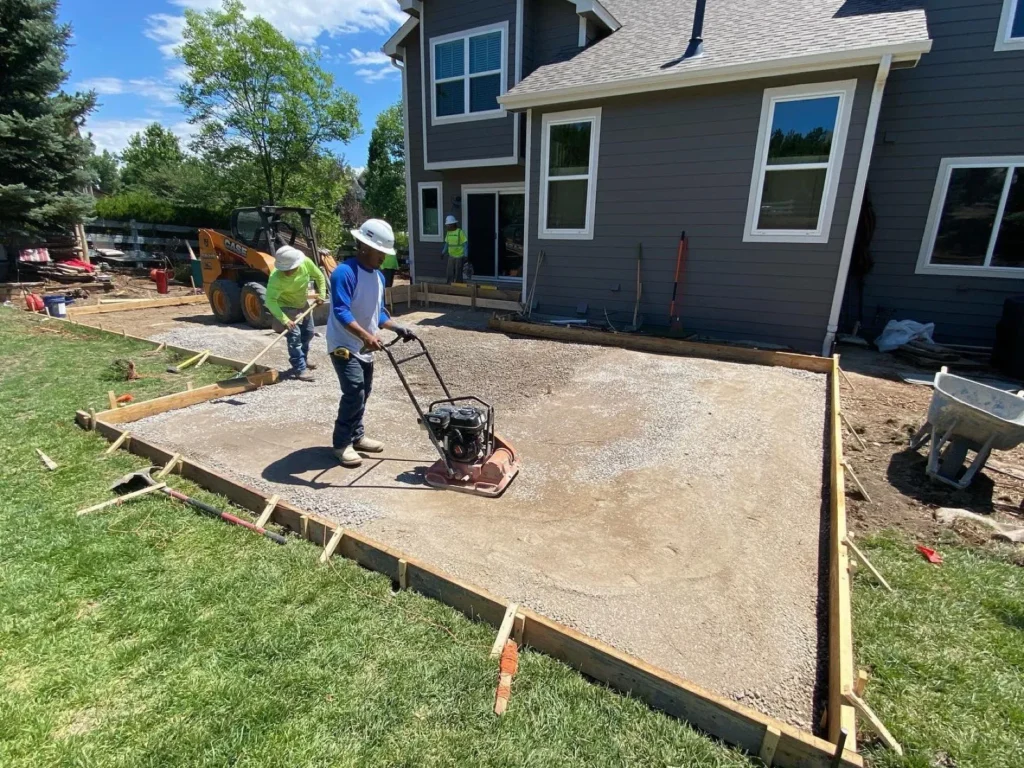
Concrete curing time is the question every client asks on the day the crew leaves, and the honest answer has three parts, because walking on a new slab, parking a car on it and driving a loaded truck across it are three different demands on the same piece of concrete.
The underlying mechanism is worth understanding, because it explains why the answers are what they are and why the weather changes them.
Concrete does not dry, it hydrates
Concrete gains strength through a chemical reaction between cement and water called hydration. That reaction needs water to continue. Concrete that dries out has not finished curing, it has stopped curing, and the strength it had not yet developed is gone permanently.
This is why curing is an active step rather than a waiting period. Curing compound sprayed on the fresh surface, wet curing with water, or covering the slab all serve the same purpose: keep moisture in the concrete while the reaction proceeds. In Denver, with low humidity, strong sun and wind, that protection matters more than it does in a damp climate.
Strength gain is fastest in the first days and then slows, continuing at a decreasing rate for a long time afterwards. The waiting periods are all about how much of that early strength has developed.
Concrete curing time: the three thresholds that matter
Foot traffic. The shortest wait. The surface has to be hard enough not to mark, which is usually a matter of a day or so in good conditions. Keep pets off as well, because paw prints set permanently, and keep the hose and the sprinklers off the surface.
Passenger vehicles. Considerably longer. The slab has to have developed enough strength to take a point load through a tyre without damaging the surface or cracking a panel. The traditional guidance for a residential driveway is about a week, and your contractor should give you a specific figure for your slab, because it depends on the mix, the thickness, the temperature and the weather since placement.
Heavy vehicles. Longest of all. A loaded truck, an RV, a delivery vehicle or a dumpster on a new driveway is a different order of load, and it warrants a full month of strength gain in most cases. This is the one people ignore, and it is the one that produces cracks in a driveway that was fine the week before.
Ask for these three numbers in writing as part of the proposal, not verbally as the crew is packing up. Our guide on comparing concrete bids lists them among the items a proposal should state.
Why cold and heat change the numbers
Hydration is temperature dependent. In cold weather it slows down, so the same mix takes longer to reach the same strength. A slab poured in late autumn may need noticeably longer before vehicles are allowed on it than the same slab poured in June, and if temperatures drop far enough the reaction can effectively pause until things warm up. That is why cold weather placement involves blankets and sometimes heat and enclosure, which we describe in our article on how we handle winter concrete projects in Colorado.
Heat has the opposite problem. High temperatures speed the reaction up, which sounds useful and is not. Concrete that sets fast gives the finishing crew a shorter window, and rapid surface evaporation in our dry air can pull water out of the top layer before it has hydrated, producing a weak surface and shrinkage cracking. The hot weather picture is in our guide to pouring concrete in Denver summer heat.
The practical consequence: the return to service times you were given are conditional on the weather that follows the pour. If the week turns cold, ask before you drive on it.
What to do, and not do, in the first week
Leave the curing measures alone. If the slab has been covered, do not pull the covering off to look at it. If a curing compound has been applied, do not wash it off.
Keep the surface clean of anything that stains. Keep sprinklers off it. Do not put anything heavy on it, including a skip, a pallet of materials or a parked trailer. Do not set ladders or scaffolding on a new slab. Keep the edges protected in particular, because edges are the weakest part of a young slab and most vehicle damage happens where a tyre runs off the side.
Barricade it properly rather than relying on people noticing. Most first week damage on residential driveways is a delivery driver who did not know.
The first winter
If the pour lands in autumn, the first winter deserves particular care. Concrete continues gaining strength for weeks, and its resistance to freeze and thaw damage develops with that strength. Keep de-icing chemicals off it for the whole first season and use sand for traction instead.
Shovel rather than letting traffic pack snow into the surface, and take slush off when things start melting so it is not refreezing on the slab every evening. The full routine is in our guide to concrete driveway maintenance in Colorado, and what happens to surfaces that are salted too early is described in concrete spalling and scaling in Colorado.
When to seal, which is not immediately
Sealing has its own timetable and it is later than most people expect. A sealer applied to concrete that is still releasing moisture can trap that moisture, and film forming sealers in particular can whiten or lift as a result. Curing compounds also need to have done their work first.
Ask your contractor for the specific waiting period for the product they intend to use, and seal in dry, moderate conditions on a clean, dry surface. Late in the day in autumn is the wrong moment, because the surface will not be dry before the temperature drops.
What normal looks like in the first month
Some colour variation is normal and usually evens out as the slab dries to a uniform shade. Efflorescence, a white powdery deposit, is common on new concrete and generally weathers off. Fine hairline crazing on the surface is cosmetic. And joints doing exactly what they were cut to do, developing a crack at the bottom of the saw cut, is the system working rather than failing.
What is not normal is a crack that crosses panels and ignores the joints, a crack with vertical displacement across it, or a panel that rocks. Photograph anything that concerns you and send it to your contractor while it is fresh. If you would like us to look at a new slab or discuss the schedule for one, start at the services page or use our quote request.
For the full range of concrete work we pour, see our concrete services.
Frequently asked questions
How long before I can drive on a new concrete driveway?
For a passenger vehicle the traditional guidance on a residential driveway is around a week, and for heavy vehicles such as loaded trucks or an RV, about a month. Both figures depend on the mix, the slab thickness and the temperatures since the pour, so ask your contractor for the numbers that apply to your slab and treat cold weather as a reason to wait longer.
Can I walk on concrete the day after it is poured?
Usually yes, once the surface is hard enough not to mark, which is typically about a day in reasonable conditions. Keep pets off as well, since paw prints set permanently, and keep sprinklers and hoses off the surface while the curing measures are still doing their work.
Does concrete cure faster in hot weather?
It sets and gains early strength faster, but that is not an advantage. Heat and our dry air pull water out of the surface before it has fully hydrated, which produces a weaker top layer and shrinkage cracking, and it shortens the window the finishing crew has to work in. Hot weather placement needs protection, not celebration.
Why should I not seal new concrete straight away?
Because it is still releasing moisture, and a sealer applied too early can trap that moisture in the slab. Film forming sealers can whiten or lift when this happens. Wait for the period the sealer manufacturer specifies for the product being used, and apply it in dry, moderate conditions on a clean, dry surface.
Is it normal for a new concrete driveway to crack at the joints?
Yes. Control joints are cut so that the shrinkage crack forms at the bottom of the saw cut in a straight line where it was planned. Seeing a fine crack follow the joint is the system working. A crack that crosses panels, ignores the joints, or has one side sitting higher than the other is a different matter and should be reported to your contractor.