

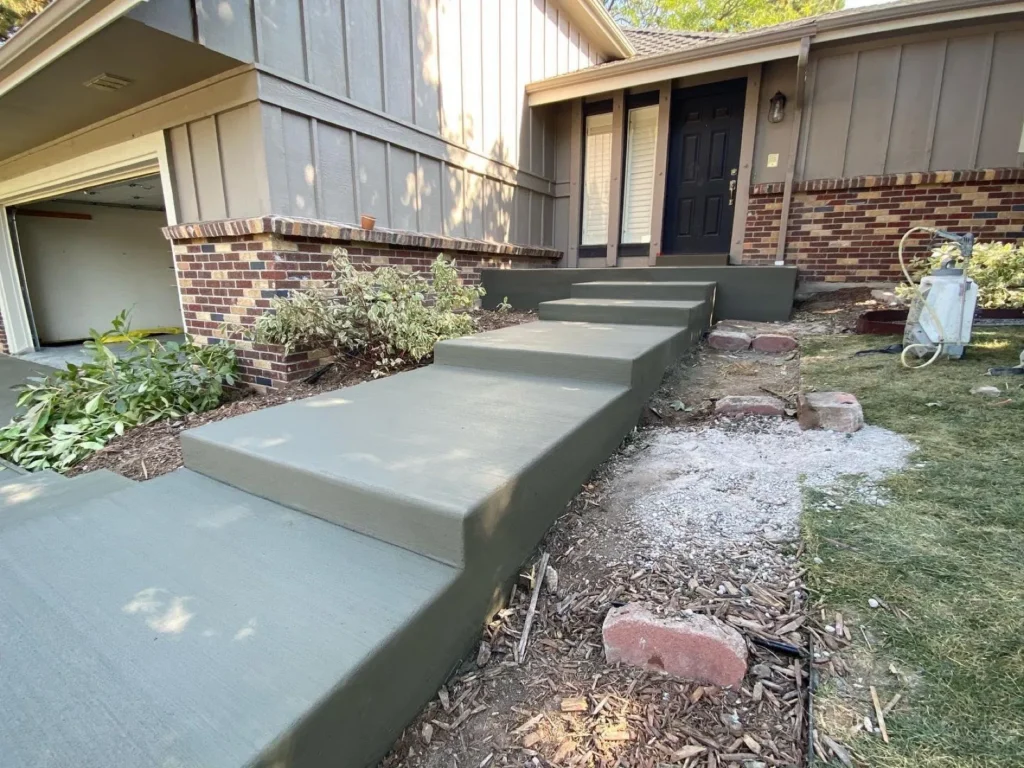
Pouring concrete in Denver summer heat is not simply a hotter version of a spring pour. The combination that makes summer work here demanding is heat plus very low humidity plus wind plus intense sun at altitude, and it is the evaporation rate rather than the thermometer that causes the damage.
Everything below is about one thing: keeping water in the concrete long enough for the surface to hydrate properly, in conditions that are constantly trying to take it out.
What actually goes wrong
Water leaves the top of a fresh slab faster than bleed water rises to replace it. When that happens, the surface begins to stiffen while the concrete underneath is still plastic, and several problems follow.
Plastic shrinkage cracking. Short, random cracks that open on the surface within hours of placement, often before the slab has been jointed. They are caused by the surface shrinking as it loses water while the body of the slab has not moved.
A weak surface layer. Cement at the top that never got the water it needed to hydrate produces a soft skin that dusts, wears and scales in later winters. This is one of the roots of the failure described in our article on concrete spalling and scaling in Colorado.
A crusted surface over plastic concrete. The top sets first and traps bleed water below it. Finishing that surface can seal the water in and create a weak plane just under the top.
A compressed finishing window. Heat accelerates the set, so the crew has far less time between placement and the moment the surface is ready to be finished and jointed. Miss it and the joints go in late, which lets the slab crack where it wants to.
Lower long term strength. Concrete that sets fast and hot generally ends up weaker than the same mix placed and cured at moderate temperature, even though it feels hard sooner.
Altitude and dry air make it worse than the temperature suggests
The number that matters is the evaporation rate, which is driven by four things at once: air temperature, concrete temperature, relative humidity and wind speed. Denver routinely supplies a punishing combination: a hot afternoon, humidity in the teens, and an afternoon breeze.
Wind is the one people underestimate. A moderate breeze across a fresh slab can increase surface evaporation dramatically, and it does it silently. A calm ninety degree day can be gentler on concrete than a windy eighty degree one. Direct sun on a dark subgrade heats the underside too, so the slab is being warmed from both directions.
What a good crew does before the truck arrives
Preparation is most of the answer, and almost all of it is scheduling and site work rather than product.
Start early. An early morning placement gets the concrete down and finished before the worst of the sun and wind. On the hottest stretches of summer, placement schedules shift accordingly.
Dampen the subgrade and the forms. A dry, hot base pulls water straight out of the bottom of the slab. Wetting it, without leaving standing water, removes that draw.
Order the mix for the conditions. Retarding admixtures extend the working time. Cooler concrete arriving at the site behaves better, and mixes can be adjusted for hot weather placement. This is a conversation with the supplier before the day, not a decision at the chute.
Have enough labour on site. Hot weather shortens the window, so the crew has to be sized for it. A pour that would be comfortable with four people in April can be a problem with four people in July.
Set up shade and wind protection where it is practical, and have curing materials on site and ready before the first truck rather than after the finishing.
During the pour
Placement should be continuous. Long delays between trucks in hot conditions create cold joints, where one section has begun to set before the next arrives, and the boundary stays as a weakness.
Water must not be added at the site to make placement easier. It weakens the paste exactly where the durability is needed, at the surface. The correct tools are admixtures and mix design.
Evaporation retarders are the specific answer to a drying surface. They are applied as a thin film after screeding to slow water loss during the wait for finishing, and they are worked into the surface rather than being a curing product. Fogging the air above the slab is another technique that raises local humidity without adding water to the mix.
Finishing has to be timed to the concrete, not the clock. The crew works when the surface is ready, which in hot conditions may be far sooner than expected. Joints must be cut as soon as the slab can take the saw without ravelling, because a late cut is a wasted cut.
Curing, immediately and continuously
In hot dry weather, curing starts as soon as finishing is complete, not at the end of the day. Curing compound applied at the correct rate, or wet curing, or covering, has to begin promptly and be maintained. A slab left uncured for a hot afternoon has already lost strength it will never recover.
This is the step most often cut short, because it happens after the visible work is finished and nobody is watching. It is worth asking, in advance, exactly which method will be used and for how long. The wider picture on service times is in our guide to curing time and driving on new concrete.
Scheduling a project around pouring concrete in Denver summer heat
Summer is a good season to pour here, provided the work is planned for the conditions. What you should hear from a contractor is an early start time, a named plan for evaporation control, curing materials on site before placement, and enough crew for the shortened window. What you should not hear is that heat makes no difference.
Expect some flexibility in the date as well. A forecast with high wind is a legitimate reason to move a pour, and a contractor who is willing to move it is protecting your slab. The opposite half of the year has its own protocol, described in our article on how we handle winter concrete projects in Colorado.
The specification items that hot weather touches, particularly jointing and curing, are set out in thickness, reinforcement and joint layout and in why flatwork prep is important. To schedule work with these conditions accounted for, start at our services page or send the details through the quote request.
Frequently asked questions
Is it a bad idea to pour concrete in the middle of a Denver summer?
No, provided the work is planned for the conditions. Early starts, a mix ordered for hot weather, evaporation control during finishing and curing that begins immediately all make summer placement perfectly sound. What causes problems is treating a hot, dry, windy day like a mild one.
What is plastic shrinkage cracking?
Short, irregular cracks that appear on the surface within hours of placement, caused by the top of the slab losing water to evaporation faster than bleed water can replace it while the concrete underneath is still plastic. It is prevented by reducing evaporation: shade, wind breaks, fogging, evaporation retarder and prompt curing.
Why does wind matter as much as temperature for a concrete pour?
Because evaporation is driven by wind speed as well as by heat and humidity. A breeze across a fresh slab pulls surface moisture away quickly and silently, so a windy moderate day can be harder on concrete than a calm hot one. It is a legitimate reason to reschedule a pour.
Should water be added to the mix on a hot day?
No. Adding water at the site makes placement easier and weakens the paste at the surface, which is exactly where durability is needed for freeze and thaw resistance later. Workability in hot weather is managed with mix design and admixtures ordered in advance, not with a hose.
Does concrete poured in summer need to be cured differently?
It needs curing sooner and more attentively. Curing should begin as soon as finishing is complete rather than at the end of the day, using curing compound at the correct rate, wet curing or covering, and it has to be maintained for the specified period. Hot, dry, windy conditions are exactly when curing is most often cut short and most needed.