

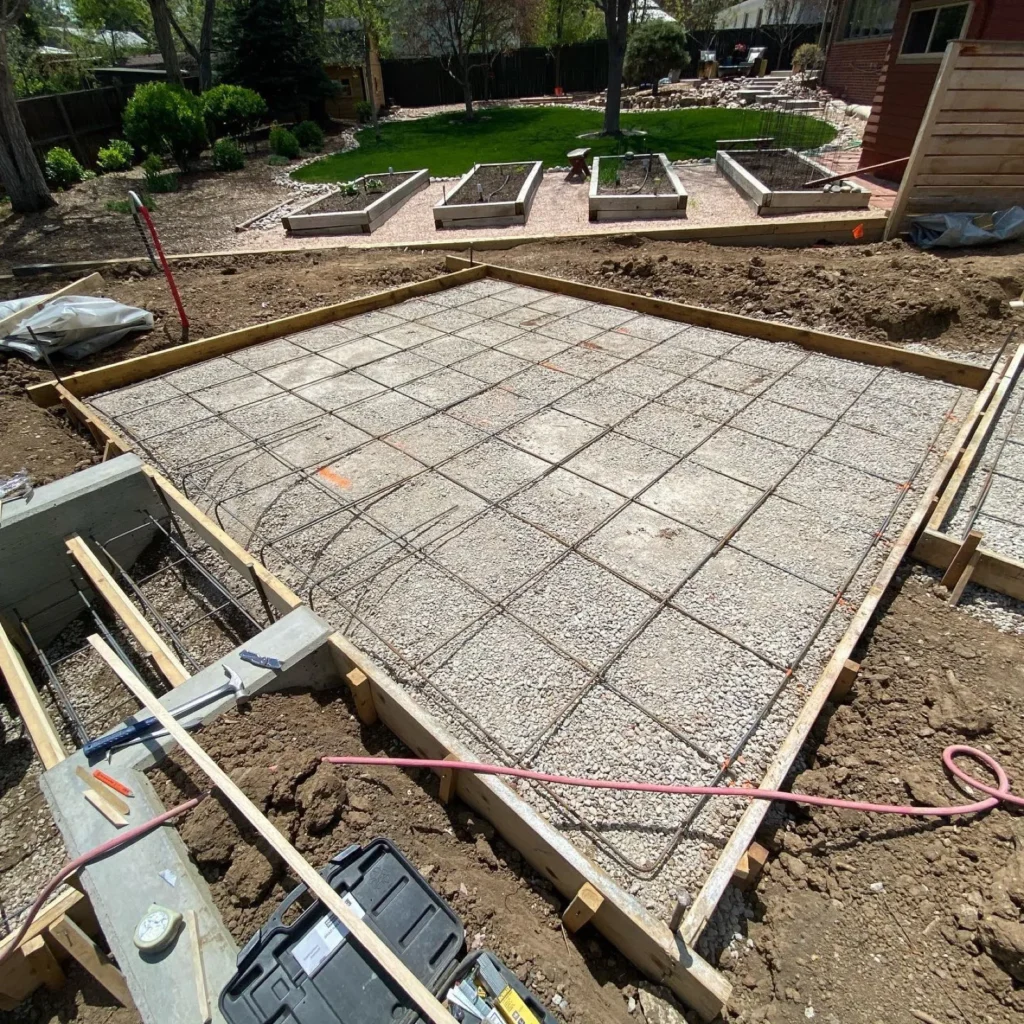
Expansive soil is the reason two identical driveways, poured by the same crew from the same truck, can look completely different after five winters. Concrete flatwork in Denver sits on clay soils that change volume with moisture, and a slab is only ever as stable as the ground holding it up.
This is not a foundation article. It is about what expansive soil does to driveways, patios, walkways and slabs on grade, and what can be done about it during construction, because almost nothing can be done about it afterwards.
What expansive soil actually is
Some clays contain minerals whose crystal structure takes water in between the layers. When they get wet they swell. When they dry out they shrink and crack. The movement is not subtle, and it is not uniform: it happens wherever the moisture changes, which means at the edges of a slab, next to a downspout, along an irrigation line, and under the part of the patio that the shade keeps damp while the rest bakes.
Differential movement is the destructive part. If the whole slab rose and fell evenly, nothing would crack. What actually happens is that one area swells while the next stays put, and the concrete has to bridge the difference. Concrete is strong in compression and weak in tension, so it cracks.
Two conditions make it worse here. Our precipitation arrives in bursts, so the soil swings between long dry spells and sudden saturation rather than sitting at a steady moisture content. And our winters freeze the top of the ground, so frost heave stacks on top of clay movement in the same months, lifting slab edges that were already under stress.
How it shows up on flatwork
The signatures are recognisable once you know them. Cracks that open in a curved or diagonal line rather than following the joints. Panels that sit visibly higher than their neighbours, often the ones nearest a downspout or a planting bed. A driveway that has heaved upward at the garage apron and now catches the door. Seasonal movement, where a gap closes in spring and opens again in late summer. And the reverse case, settlement, where a slab drops after clay that was wet during construction has dried out under it.
Our guide on why concrete driveways crack in Colorado covers how to read a crack, and repair, resurface or replace covers what to do once you have read one.
Moisture control is the whole strategy
You cannot change the clay under your property, but expansive soil only misbehaves when its moisture content changes. Keeping that content stable is most of the job, and much of it is landscaping rather than concrete.
Downspouts should discharge well past the edge of any slab, not beside it. The ground should fall away from the house and from the concrete rather than toward it. Irrigation should not be aimed at the edge of a driveway or run in a line right beside a patio, because a permanently wet strip next to dry ground creates exactly the differential the slab cannot handle. Trees are the other half of this: a mature tree draws a great deal of water out of the soil in summer, and the shrinkage bowl around it can pull a slab down.
The point is not to keep the soil dry. It is to keep it consistent.
What good construction does about it
Design decisions made before the pour are what separate a slab that copes from one that does not.
Subgrade preparation. Excavate through soft and organic material, and remove any soil that has been disturbed and left uncompacted, such as an old utility trench. Then bring the area up with imported granular base compacted in lifts to a specified thickness, and test it rather than assume it. That base spreads load and breaks the direct connection between the swelling clay and the slab. This is the work described in our guide on why flatwork prep is important.
Moisture conditioning. Clay that is bone dry at the time of construction has nowhere to go but up once it gets wet. Bringing the subgrade to a consistent moisture content before placing base material is a real technique and it is a distinguishing mark of a crew that knows the local ground.
Reinforcement. Reinforcement does not stop concrete cracking. It holds the pieces together and keeps a crack tight rather than allowing it to open and displace. On expansive soil that is a meaningful difference, and it is the argument for a designed rebar mat on chairs rather than mesh lying wherever it landed. The detail is in our article on thickness, reinforcement and joint layout.
Joint layout. Control joints let the slab crack in straight lines where you chose. Panel sizes have to be sensible, the joints have to be cut deep enough and early enough, and the layout has to work with the shape rather than ignoring it.
Isolation. Flatwork should be separated from the house, from columns and from any structure that is supported differently. An isolation joint at the foundation lets the slab move without dragging the wall or transmitting movement into it.
Where drilled piers and structural solutions come in
Ordinary residential flatwork sits on grade and is designed to move a little. Structures that must not move are supported differently, and on Front Range soils that often means drilling through the expansive layer to competent material. That is a structural design matter and it belongs to engineers rather than to a flatwork crew, but it is worth understanding the distinction, which our article on drilled piers and when they are needed explains. Anything touching the house structure itself belongs on our foundations page.
What to ask a contractor bidding flatwork on clay
Ask what base material they intend to use and to what compacted thickness. Ask how compaction will be verified. Ask what they plan to do if the excavation reveals soft or organic soil. Ask how the slab will be isolated from the house and how the joints will be laid out. Ask where they intend the water to go once the surface is finished.
A crew that has poured a lot of concrete in the Denver metro will have immediate answers, because these are the conditions they work in daily. Vagueness on the base and the drainage is the warning sign. If you want that assessment on your property, start from the flatwork service page or send us the details through the quote request.
Frequently asked questions
How do I know if my property has expansive soil?
Much of the Denver metro and the wider Front Range sits on clay soils with some expansive behaviour, so the safer assumption is that yours does. The visible signs are deep shrinkage cracks in bare soil in late summer, ground that becomes sticky and swells after prolonged wet weather, and existing flatwork nearby that has heaved or cracked in curved lines. A geotechnical report gives the definitive answer.
Can a concrete slab be built so expansive soil never cracks it?
No honest contractor will promise that. What good construction does is make cracking predictable and harmless: joints so the crack goes where you chose, a compacted base so movement is reduced and evenly distributed, reinforcement so any crack stays tight, and drainage so the moisture content under the slab stays stable.
Does a thicker slab solve expansive soil movement?
Only partly. Thickness helps the slab bridge small inconsistencies, but if the ground under one part swells and the ground under the next does not, thickness alone does not resolve the difference. The base preparation and the moisture control do more than the extra concrete does.
Why did my new patio crack in the first year?
The common causes are a base that was not compacted properly or was placed on soft ground, joints that were cut too shallow or too late, water reaching the subgrade from a downspout or irrigation, and shrinkage during a hot, dry pour. The crack pattern and its location usually indicate which one, so photograph it before anything is filled.
Should I water the soil around my concrete in a dry summer?
Consistency is what you are after. Extremes in either direction cause movement, so soil that has been allowed to dry out completely and is then soaked will move sharply. Steady, moderate watering that keeps conditions even, with the water kept away from the slab edge and the foundation, is better for the concrete than alternating drought and flood.