

Concrete driveway thickness, reinforcement and joint layout are the three specification decisions that decide how a slab behaves for the next thirty years, and all three are invisible the moment the finish is troweled. They also happen to be the three items most often missing from a residential proposal.
This is what each one does, how they interact, and what to ask for in writing before the forms go in.
Concrete driveway thickness follows the loads, not the fashion
A driveway slab is designed for what will actually cross it. Two passenger cars is a modest demand. A three quarter ton truck towing a trailer, a motorhome, a delivery vehicle turning around, or a landscaping truck making regular visits is a different problem entirely, and the answer is a thicker slab rather than a stronger mix.
Two zones deserve extra attention. The apron at the street, where every vehicle enters at an angle and where the municipality may have its own requirement, and the area at the garage door, where vehicles turn and where the slab edge meets a threshold. Both take more abuse than the middle of the driveway.
Thickened edges are the other half of the conversation. Slab edges are the weakest part of any flatwork, and edges that will be driven over, at the street transition, at the sides where tyres run off, or at a turnaround, benefit from being deepened. The failure most often reported as a cracked driveway started as a broken edge.
Reinforcement does not prevent cracks
This is the most useful sentence in the article. Reinforcement does not stop concrete from cracking. Concrete shrinks as it cures and it cracks somewhere. What reinforcement does is hold the two sides of a crack together so it stays tight and stays level, instead of opening and displacing vertically. On soils that move, that difference is what separates a hairline you never think about from a trip hazard.
There are three approaches and they are not interchangeable.
Fibre in the mix. Synthetic fibres distributed through the concrete reduce plastic shrinkage cracking in the first hours. They are a useful addition and they are not a structural reinforcement. Fibre alone does not do the job of steel across a working crack.
Welded wire mesh. Sheets or rolls of light steel mesh. Mesh works only if it is held at the correct height within the slab. Mesh laid on the base and left there does nothing at all, and mesh pulled up with a hook during the pour ends up at unpredictable heights. Sheets on chairs are considerably better than rolls.
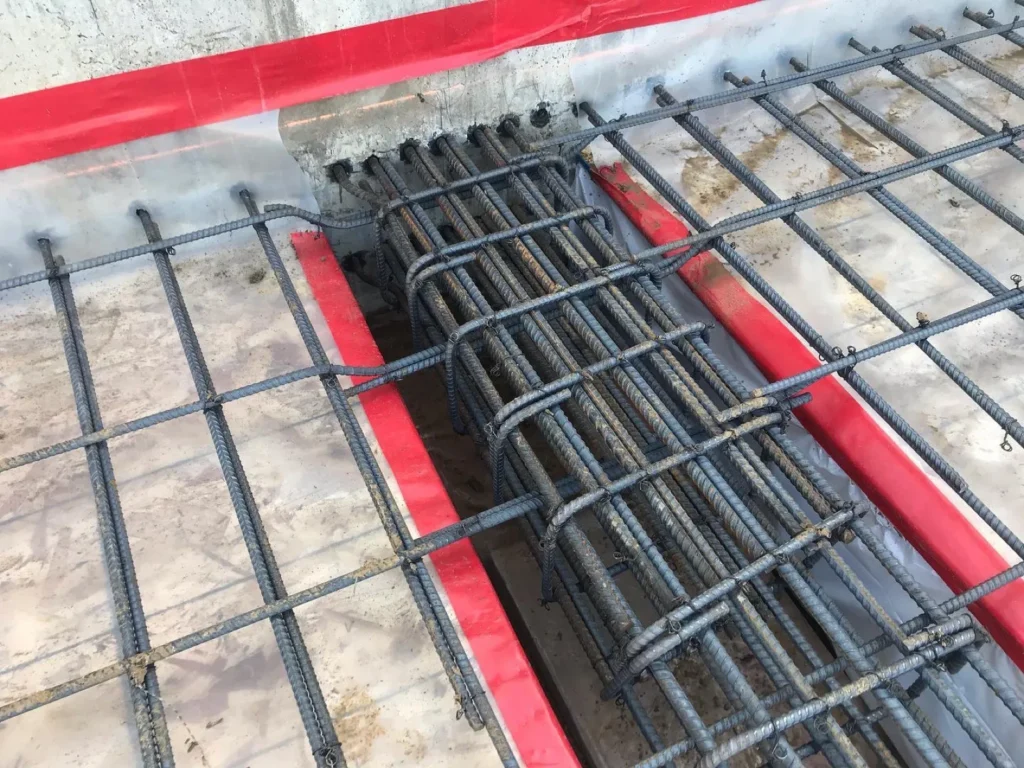
Reinforcing bar. A mat of steel at a stated bar size and spacing, supported on chairs at the design height, with the correct lap at splices and adequate cover from the surface. This is the approach that gives predictable behaviour, and it is the one to specify on expansive soil, on driveways carrying heavy vehicles, or on any slab where a crack opening up would be a real problem.
Whatever is chosen, the proposal should say how the steel will be supported. That single line separates reinforcement that works from reinforcement that is present.
Joints decide where the cracking happens
Control joints, also called contraction joints, are deliberate lines of weakness. As the slab shrinks, it cracks at the bottom of the saw cut instead of wandering across the driveway. Four things have to be right.
Depth. A joint cut too shallow does not control anything and the slab cracks beside it.
Timing. Joints have to be cut as soon as the slab will take the saw without the edges ravelling, and before shrinkage stresses have built up. In hot, dry, windy weather that window arrives sooner than people expect, as our article on pouring concrete in Denver summer heat describes.
Layout. Panels should be close to square rather than long and thin, joints should meet corners and line up with edges and steps, and re-entrant corners, the inside corners created by an L shaped driveway or a cut-out around a post, need a joint running out from them because cracks start at inside corners.
Isolation joints. Different from control joints. These fully separate the driveway from things that move differently: the garage foundation, a public sidewalk, a wall, a post. They are formed with a compressible material through the full slab depth. Concrete cast tight against a foundation transmits movement into it.
Ask for the joint plan as a drawing rather than a sentence. A contractor who has thought about the layout will produce it easily, and you get to see the finished pattern before it exists.
How the three work together on Front Range soils
On expansive clay the ground swells and shrinks with moisture, and it does so unevenly. Thickness helps a slab bridge minor inconsistencies in support. Reinforcement keeps a crack tight when the ground moves anyway. Joints decide where that crack appears. None of the three substitutes for the others, and none of them substitutes for a properly compacted base, which is the foundation of the whole system and the subject of our guide on why flatwork prep is important.
The soil behaviour itself is covered in expansive soil and concrete flatwork, and how these decisions show up in the price is in our guide to concrete driveway replacement cost.
The mix belongs in the same conversation
Specification is not only geometry. Exterior concrete in this climate needs entrained air to survive freeze and thaw cycling, and a stated compressive strength with a sensible water to cement ratio. A well designed slab poured from a weak, over watered mix still fails at the surface, which is what happens in the scaling described in our article on concrete spalling and scaling in Colorado.
What to put in writing
Slab thickness, stated as a number, with any thickened edges or zones identified. Reinforcement type, size and spacing, and how it will be supported at height. Mix compressive strength and air entrainment. Joint layout as a drawing, with joint depth and the cutting method and timing. Isolation joint locations and the material used. Base material and compacted thickness. Curing method and duration.
Those items make a proposal comparable with another proposal, which is the subject of our guide on comparing concrete bids. To have your driveway specified this way, start from the driveway service page or send the details through our quote request.
Frequently asked questions
How thick should a concrete driveway be?
Thickness is set by the heaviest vehicle that will use it regularly, not by a default. A driveway for passenger cars is specified differently from one carrying a loaded truck, an RV or regular delivery vehicles. Ask your contractor to state the thickness as a number in the proposal, along with any thickened edges or zones, and tell them what you actually park and tow.
Do I need rebar in a concrete driveway?
Reinforcement does not prevent cracking, it keeps cracks tight and level when they occur. On expansive soils, or where heavy vehicles are involved, a designed rebar mat supported on chairs gives the most predictable result. Fibre in the mix helps with early shrinkage cracking but is not a substitute for steel across a working crack.
What happens if control joints are cut too late?
The slab cracks before the joints can control it, and those cracks go wherever the stresses take them rather than following the plan. Joints have to be cut as soon as the concrete will take the saw without ravelling. In hot, dry, windy conditions that window comes much sooner, which is why summer pours need the saw crew ready.
What is the difference between a control joint and an expansion joint?
A control joint is a cut partway into the slab that makes the shrinkage crack form in a straight, chosen line. An isolation or expansion joint runs the full depth and completely separates the driveway from something that moves differently, such as the garage foundation, a wall or a public sidewalk. They do different jobs and a slab usually needs both.
Does welded wire mesh work in a driveway?
Only if it is held at the correct height in the slab. Mesh lying on the base contributes nothing, and pulling it up with a hook during placement leaves it at unpredictable depths. Flat sheets on chairs are far better than rolls, and where the reinforcement really matters, a designed bar mat is the more reliable specification.