

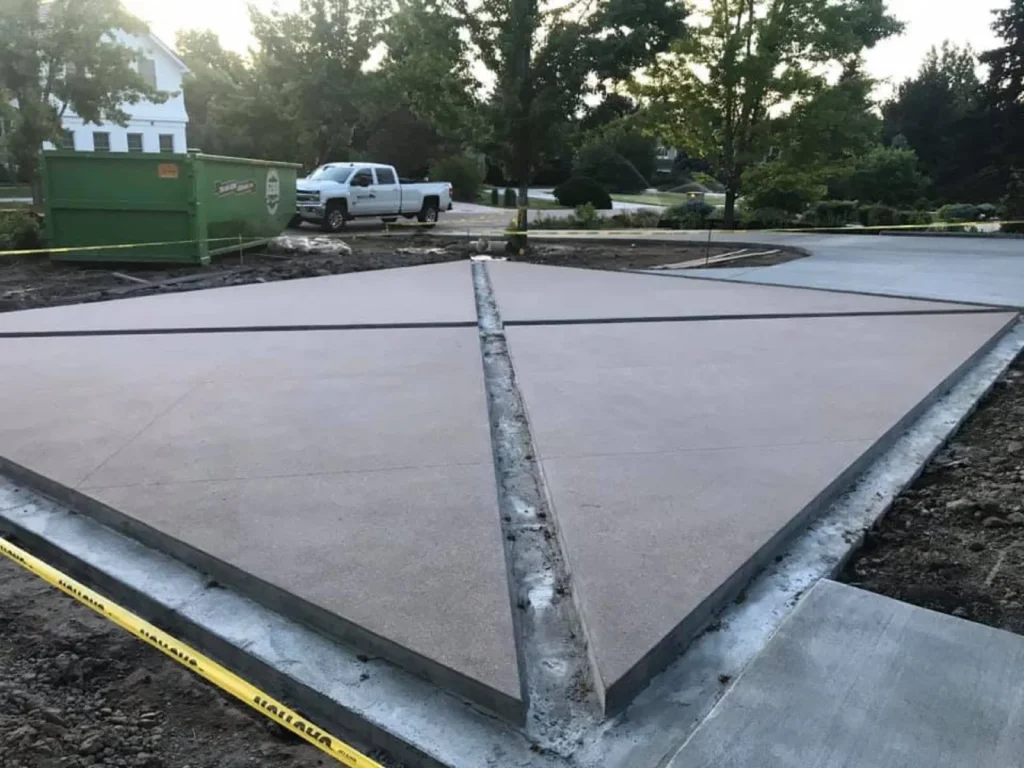
The decision to repair, resurface or replace a concrete driveway is not a taste question. It is decided by what is happening underneath the slab, and there is a sequence of checks that gets you to the answer in about twenty minutes without any special equipment.
Get the diagnosis wrong in the cheap direction and you pay twice: an overlay laid over a moving slab cracks in the same places within a season or two. Get it wrong in the expensive direction and you demolish a driveway that had years left in it.
Start by asking whether the base is still doing its job
Everything follows from this. The slab is only as good as the compacted ground under it, and on Front Range clay soils that ground moves when it takes on water. Four symptoms tell you the base is the problem rather than the surface.
Rocking or a hollow sound. Stand on a panel near a crack and shift your weight. Movement, or a hollow tap when you strike it, means a void underneath.
Vertical displacement at a crack. Run your hand across it. If one side sits proud of the other, the two halves are supported differently. That is a base failure, not a concrete failure.
Ponding. Water standing in a low spot after rain, particularly if it was not there when the driveway was new, means a section has settled.
Cracks that keep coming back. A crack that has been filled twice and reopened in the same line is being driven by movement below.
Where any of those are present, surface work is money spent on a symptom. Our guide on why concrete driveways crack in Colorado covers how these cracks develop, and expansive soil and concrete flatwork explains the soil behaviour behind them.
Then look at the surface on its own terms
If the slab is stable, the surface has its own set of conditions. Scaling is the loss of the top layer in flakes, usually from de-icing salts on concrete that was not properly air entrained or was finished while bleed water was still on the surface. Spalling is deeper, with chunks breaking away, often over reinforcement that is close to the surface. Crazing is the fine web of hairline cracks that looks alarming and is almost always cosmetic. Discolouration and wand marks from pressure washing are cosmetic too.
Surface conditions on a stable slab are exactly what resurfacing is for. What causes them, and how to stop them recurring, is the subject of our article on concrete spalling and scaling in Colorado.
When repair is the right answer
Repair means treating specific defects and leaving the rest alone. It fits a driveway that is fundamentally sound with a small number of localised problems.
Typical repair work is routing and sealing cracks with a flexible material so water stops reaching the base, replacing failed joint sealant, patching a spalled area at a joint edge or the garage apron, and cutting out and replacing a single failed panel where the joints give a clean boundary. Panel replacement is underrated. Where a driveway has one settled section and five good ones, replacing that section and correcting the base under it costs a fraction of a full replacement and lasts.
Slab lifting, injecting material under a settled panel to raise it, also belongs here. It is the right tool when a slab is sound but sitting low, and the wrong tool when the slab is broken up, because you cannot lift something that is no longer acting as one piece.
When resurfacing works
A resurfacer or overlay is a thin cementitious layer bonded to the existing slab. It gives you a new surface, and with a stamped or textured overlay, a new appearance. It requires three things to be true.
The slab must be structurally sound, with no rocking, no vertical displacement and no active settlement. The surface must be preparable, which means mechanical profiling so the overlay has something to key into. And the existing cracks and joints must be honoured, because an overlay does not bridge movement. Every joint has to be reproduced through the new surface, and any crack that is still moving will reappear.
The other constraint is elevation. An overlay raises the surface, so check what happens at the garage door, at the threshold, and where the driveway meets the public walk. A quarter of an inch matters at a garage door seal.
When replacement is the honest answer
Replace when the base has failed across a meaningful part of the driveway, when panels rock, when there is displacement at multiple cracks, when the slab is broken into more pieces than it has joints, or when drainage is directing water at the house and the grade has to be rebuilt.
Age alone is not a reason. A forty year old driveway that sits flat, drains correctly and has tight joints is doing its job. The trigger is behaviour, not birthdays.
Replacement is also the moment to fix the things a surface treatment can never touch: the base depth, the compaction, the slab thickness for the vehicles you actually own now, the joint layout, and the grade. What that involves is set out in our guide to what drives concrete driveway replacement cost and in the specification detail on thickness, reinforcement and joints.
How to decide whether to resurface or replace a concrete driveway
Walk the driveway and mark every crack with chalk. Note which ones have displacement across them and which do not. Stand on each panel next to a crack and shift your weight, listening and feeling for movement. Look at the joints and check whether the sealant is intact. Look for ponding, or for the staining that shows where water sits. Check the edges for undermining, where soil has washed out from beneath the slab. Look at the transition to the garage apron, which is usually where movement shows first.
Count the panels involved. One or two bad panels in a driveway of ten is a repair conversation. Six of ten is a replacement conversation. That ratio, more than any single crack, is what decides it.
What to ask a contractor before you agree to anything
Ask what they think the cause is, not just what they propose to do. Ask specifically whether they believe the base is intact and what evidence they are using. Ask, if they are proposing an overlay, how they will prepare the surface and how they will handle existing joints and cracks. Ask what the failure mode is if the diagnosis is wrong.
A contractor who recommends replacement should be able to say why repair will not hold. One who recommends an overlay should be able to say why the slab underneath is trustworthy. If you would like that assessment on your driveway, start at the driveway service page or send photographs through our quote request.
Frequently asked questions
How do I know whether my driveway needs repair or full replacement?
Count the panels, not the cracks. If a small number of panels are affected and the rest sit flat with tight joints and no rocking, targeted repair or panel replacement is the right scope. If most panels show movement, displacement or ponding, the base has failed broadly and replacement is the honest answer.
Can you resurface a cracked concrete driveway?
Only if the cracks are stable and the slab is not moving. An overlay is a thin bonded layer, and it reflects whatever the slab beneath it does. Existing cracks have to be treated and every joint has to be carried through the new surface, or the pattern will reappear within a season or two.
Is slab lifting worth doing on a settled driveway?
It is a good solution for a sound panel that has settled, because it corrects the elevation without demolition. It is the wrong solution when the panel is broken into pieces, when the underlying soil is still moving because water is not controlled, or when the drainage problem that caused the settlement has not been fixed first.
How long should a concrete driveway last in Colorado?
A slab built on a properly prepared and compacted base, with air entrained concrete, sensible jointing and drainage that moves water away, lasts decades here. Most driveways that fail early failed at the base or at the drainage, not in the concrete itself.
Should I fix drainage before replacing the driveway?
Drainage should be corrected as part of the replacement, not afterwards. If water is being directed at the slab or at the house, a new driveway on the old grade repeats the failure. The grade, the downspout discharge points and any drain are part of the design, and they belong in the proposal.