

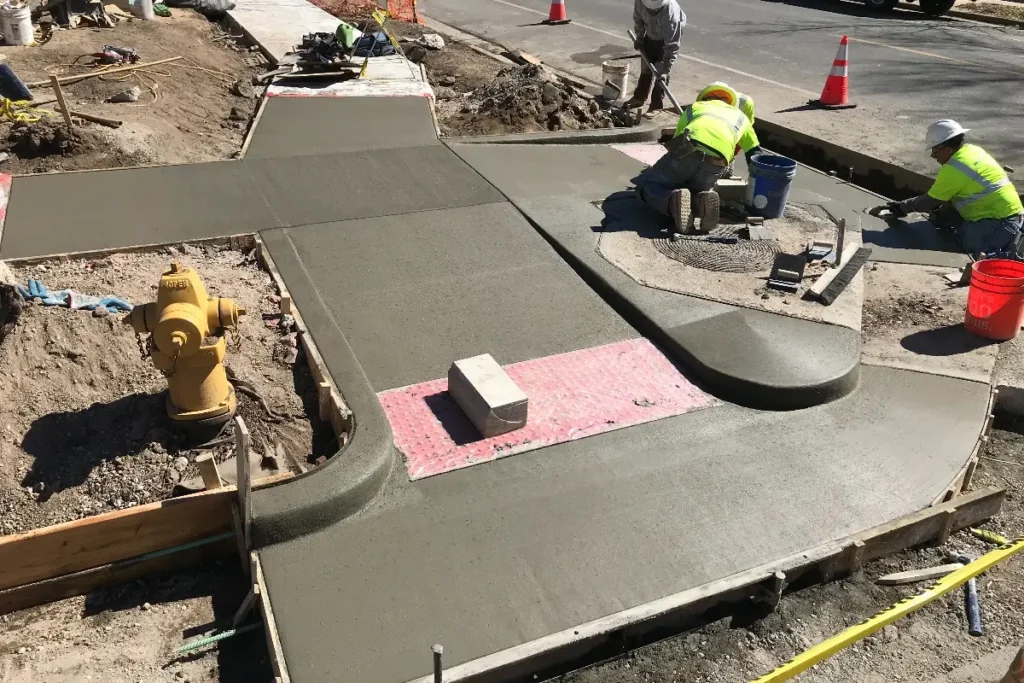
Most homeowners assume their property runs to the edge of the pavement, and it usually does not. The strip that is not theirs contains the two pieces of concrete that fail first: the driveway approach where the drive meets the street, and the public sidewalk crossing in front of the house.
Work in that strip is governed by the municipality rather than by you, even though you are usually the one paying for it. Finding that out after a saw is running is an expensive way to learn it.
Three terms that are not the same thing
The property line is where your legal ownership ends. Your survey and your deed state where it is.
The right of way is the corridor the street occupies, and it is typically much wider than the paved surface. Depending on how your subdivision was platted, the public may own that corridor outright, or you may own the ground beneath it while the public holds the right to use and control it. Either way, what happens inside it is governed by the municipality.
An easement is a right someone else holds over part of your property for a defined purpose, most often a utility. It does not change who owns the ground and it does change what you can build on it.
The practical consequence is that owning a piece of ground and being free to pour concrete on it are two different questions. The second one is answered by the municipality rather than by your deed.
The driveway approach
The approach, sometimes called the apron, is the section between the street and roughly your property line. It takes the heaviest loading on the property, every vehicle crosses it, and it is almost always inside the right of way, which makes it the one piece of your driveway you do not fully control.
In most Denver metro jurisdictions, replacing an approach requires a permit from the municipality or the relevant transportation department, and the permit comes with a specification. That specification typically governs the thickness, the width, the flare geometry at the street, the reinforcement, the jointing, and sometimes the mix.
Those requirements exist because the municipality is responsible for what happens in its right of way. An approach that heaves, settles or breaks up becomes its problem, so it sets the standard rather than leaving it to the homeowner.
Three consequences follow for anyone getting driveway quotes.
The approach is usually built thicker than the residential driveway behind it, so a quote that carries one thickness all the way to the street has either overbuilt the drive or underbuilt the approach.
A quote that includes the approach should say which specification it is being built to and whether the permit and the inspection are in the price.
And two quotes that differ substantially on a driveway replacement sometimes differ because one of them quietly stops at the property line. That is worth asking about directly before comparing the totals.
Our guide to driveway thickness, reinforcement and joints covers the structural side of the rest of the drive.
The public sidewalk
Where a street has a sidewalk, the usual arrangement across the metro is that the walk sits in the right of way, the municipality controls it, and the adjacent property owner is responsible for maintaining it and keeping it clear.
That split surprises people. You do not get to decide to remove it, narrow it, reroute it or change its material. You may well be the one required to repair it when it becomes a hazard, and you may be the one who receives the notice when the city inspects.
What counts as a defect requiring repair is defined locally, and the common triggers are vertical displacement between panels, cracking severe enough to create a trip hazard, and panels that have settled or heaved. Along the Front Range, expansive soils and freeze cycles produce both, and mature street trees produce the rest.
Some municipalities run inspection programs on a cycle and mark defective panels with paint, then send a notice with a deadline attached. Some operate cost-sharing programs. Some do the work themselves and assess the cost to the property. Those are very different financial outcomes, and the notice is the document that tells you which applies.
Our general guidance on this work is in what property owners should know about sidewalks and sidewalk replacement.
Curb, gutter and the drainage that is not yours
The curb and gutter in front of the property is also right of way, and it is doing a job for the whole street rather than for your lot. That changes who gets to decide what happens to it.
That matters when a driveway approach is replaced, because the approach has to meet the gutter line correctly. Get that wrong and you create either a lip that catches a snow plow or a low point that ponds. A municipality’s approach specification usually addresses this directly, which is another reason the permit drawing matters.
Where curb and gutter itself is being replaced, that is a different scope with its own requirements, covered in concrete curb and gutter.
Which authority, and how to find out
In an incorporated city the municipality controls its own local streets. In unincorporated county areas the county is the authority. State highways are a separate and more involved permission, and a driveway onto one is a different conversation than a driveway onto a subdivision street.
The first question on any work near the street is which authority governs that specific street. Your contractor should know for the jurisdictions they work in, and where it is unclear a single phone call to the city or county office settles it.
For commercial sites the review is broader, because an access point onto a public street involves sight distance, turning movements and sometimes a traffic review. That work sits in our civil site work and municipality scope, and it starts earlier in the design than most owners expect.
Winter, clearing duty and what it does to concrete
Most municipalities with sidewalks have an ordinance requiring the adjacent owner to clear snow and ice within a set time after a storm. Enforcement varies and the obligation does not.
That duty creates pressure to use de-icing chemicals heavily, and that is exactly the behavior that destroys the surface of concrete, particularly concrete in its first winters. The mechanism is covered in concrete spalling and scaling in Colorado.
On new work the practical answer is sand for traction through the first winter and sealing on a maintained schedule afterward, which is the subject of concrete driveway maintenance in Colorado. A new approach salted hard in its first January will look a decade old by its third.
Matching existing public work
Replacing two sidewalk panels in a run of twenty is a matching problem that nobody fully solves. New concrete is lighter than old concrete and stays visibly different for a long time, panel dimensions have to follow what the municipality specifies now rather than what was poured decades ago, and joint spacing on the new work may not line up with the old.
That is worth knowing before the work rather than after. If the appearance of a continuous run matters, replacing more of it at once gives a better result than replacing the minimum the notice demanded, and that is a cost decision to make deliberately.
What to establish before you sign
Five questions, and your contractor should answer all of them for your address: which authority controls the street, whether the work extends into the right of way, whether a permit is required and who is pulling it, what specification the approach or walk has to meet, and what in the right of way is being disturbed that has to be restored.
If the answers are vague, that is a reason to make the call yourself before the deposit rather than after the demolition. The rest of what separates two bids is in how to compare concrete bids in Denver.
Frequently asked questions
Do I own the sidewalk in front of my house?
In most Denver metro jurisdictions the walk sits in the public right of way and is controlled by the municipality, while the adjacent owner is responsible for maintaining it and clearing it. That means you generally cannot remove it, narrow it or change its material, and you may still be the one required to repair it. The specific arrangement is local, so confirm it with your city or county for your address.
Do I need a permit to replace my driveway approach?
Usually yes, because the approach sits inside the right of way even though you pay for it. The permit normally comes with a specification covering thickness, width, flare geometry, reinforcement and jointing. Your contractor typically pulls it, and one who does not know whether it is required for your jurisdiction is worth a second look before you sign.
Why is the approach thicker than the rest of my driveway?
Because it carries the heaviest loading on the property, including delivery trucks and anything else that crosses it to reach the street, and because the municipality specifies it that way. A quote that carries the residential driveway thickness all the way out to the street has either overbuilt the drive or underbuilt the approach, and the second is the one that fails first.
The city marked my sidewalk. Who pays?
That depends entirely on the municipality. Some require the owner to arrange and pay for the repair, some run a cost-sharing program, and some do the work and assess the cost to the property. The notice you received is the document that tells you which applies, along with the deadline and the standard the replacement has to meet. Read it before collecting quotes, because it usually constrains the scope.
Why do two driveway quotes differ so much?
Frequently because one includes the approach and the permit and the other stops at the property line. The approach is built to the municipality’s specification rather than to residential thickness, it usually carries a permit and an inspection, and it has to meet the gutter line correctly. None of that shows up in a square foot price, which is why the scope matters more than the total.